Long Beach Habitability Inspection Checklist (2026)

Short answer: In Long Beach, a rental building with four or more units is covered by the city’s Proactive Rental Housing Inspection Program (PRHIP). Inspectors give at least 14 days’ mailed notice, then check the exterior, common areas, exits and at least 10% of the units against building, housing and sanitation codes. Every California rental must also meet the habitability list in Civil Code 1941.1, which since January 1, 2026 includes a working stove and refrigerator for new, amended or renewed leases.

Key takeaways

  • PRHIP covers Long Beach rental properties with at least 4 residential units (permitted ADUs and JADUs don’t count toward the 4).
  • Owners register within 60 days of buying or converting the property, and pay a yearly fee due November 1. A 25% penalty is added 30 days after the due date.
  • Inspectors look at the outside, common areas and exits, ask for access to at least 10% of units, and can widen to every unit if they find violations.
  • Voucher units get a separate Housing Authority inspection under HUD’s NSPIRE standard, with its own list of commonly failed items.
  • Use the room-by-room checklist below the week before any inspection, move-in or move-out.

Which Long Beach inspection are you facing?

“Habitability inspection” can mean four different things in Long Beach. Each has its own rules, so start by finding yours.

InspectionWho runs itWhich homesWhen it happens
Proactive Rental Housing Inspection Program (PRHIP)City of Long Beach Code EnforcementRental properties with 4 or more unitsPeriodic, with at least 14 days’ mailed notice
Housing Choice Voucher inspectionHousing Authority of the City of Long Beach (HACLB)Units leased with a voucherBefore move-in, then annual or biennial, plus re-inspections and complaint inspections
Habitability Inspection Standards FormCity-funded assistance programs (case managers)Units where a program participant gets move-in or rent help (non-HUD CoC programs)Before the participant moves in
Move-in and move-out photosThe landlordEvery California rental with a security depositAt the start of tenancies from July 1, 2025, and after move-out

Sources: Long Beach Municipal Code ch. 18.30, HACLB Inspections, the city’s Habitability Inspection Standards Form (effective January 1, 2025) and Civil Code 1950.5, all read November 2026.

What “habitable” means under California law

Civil Code 1941.1 lists what a rental must have. A home that substantially lacks any of these can be treated as untenantable:

  • Waterproofing and weather protection of the roof and outside walls, including unbroken windows and doors.
  • Plumbing and gas facilities in good working order.
  • Hot and cold running water connected to an approved sewage system.
  • Heating in good working order.
  • Electrical lighting, wiring and equipment in good working order.
  • Building and grounds clean and free of debris, garbage, rodents and vermin, with enough trash and recycling receptacles.
  • Floors, stairways and railings in good repair.
  • New in 2026: a working stove and a working refrigerator, for leases entered into, amended or extended on or after January 1, 2026. A recalled stove or fridge doesn’t count as working. A tenant can choose to bring their own fridge only if the lease includes the required statement. Some housing types are exempt, such as permanent supportive housing, single-room occupancy units and residential hotel units.

Source: California Civil Code 1941.1, read November 2026. This is general information, not legal advice. Check your situation with a California real estate attorney.

How a PRHIP inspection works, step by step
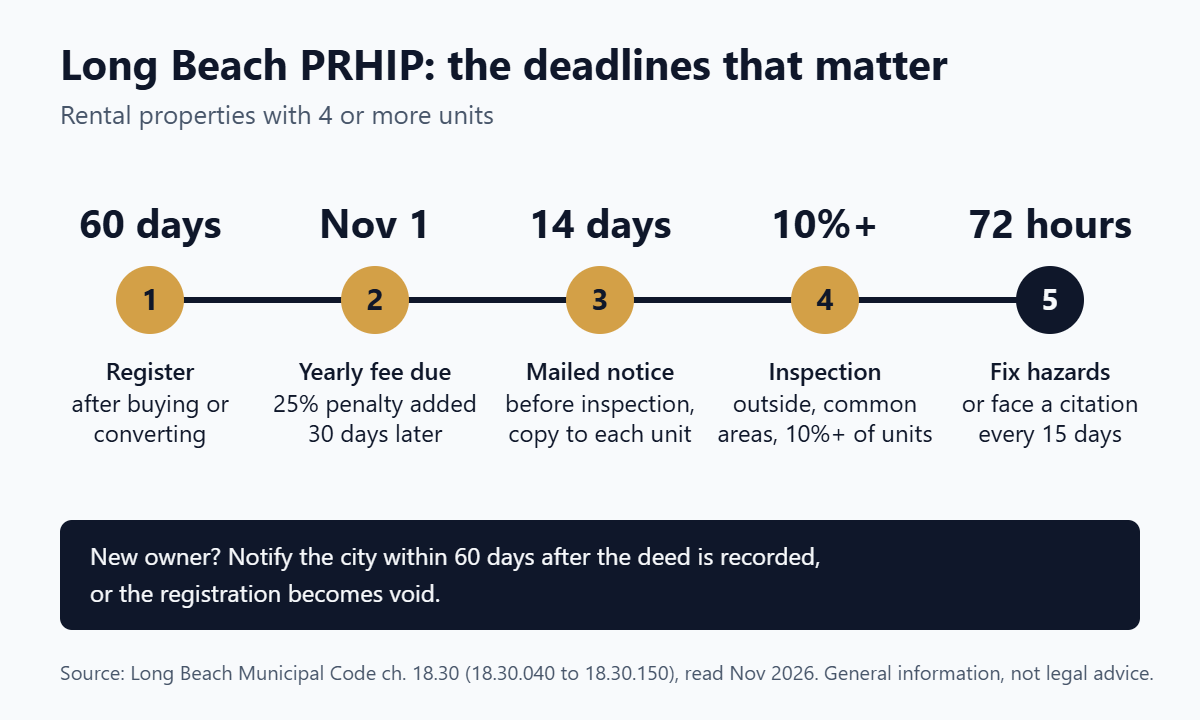
Timeline of Long Beach PRHIP deadlines: register within 60 days, fee due November 1, 25% penalty after 30 days, 14 days of mailed notice, 72 hours to fix imminent hazards
Key PRHIP deadlines. Source: Long Beach Municipal Code ch. 18.30, read November 2026.
  1. Register. Each owner registers on the city’s form within 60 days of buying or converting the property, and names a contact representative with a phone number and mailing address.
  2. Pay the yearly fee. The PRHIP fee is set in the city’s Master Fee and Charges Schedule and is due November 1 (or, for a new purchase, a prorated amount within 60 days). After 30 days the city adds a 25% penalty, and unpaid amounts can become a lien that bears 12% interest a year.
  3. Get notice. The city mails the inspection date and time to the owner and contact at least 14 calendar days ahead, and mails a copy to each unit.
  4. Inspection day. Inspectors check the exterior, all common areas and all exits, and ask for access to at least 10% of units and garages. If they find violations, they can inspect up to 100% of the units.
  5. Fix and re-inspect. Violations are written up with what must be done. Re-inspections can carry a fee. For a condition that’s an imminent threat to health and safety, the owner has 72 hours to fix it before the city can issue an administrative citation every 15 days.

Source: LBMC 18.30.040 to 18.30.130. Questions go to Long Beach Code Enforcement at 562-570-2633 (PRHIP page).

Room-by-room habitability inspection checklist

Walk the property with this list a week before an inspection, at move-in and at move-out. Take a wide photo and a close-up of anything that needs work.

AreaWhat to checkWhy it matters
Outside and roofNo missing roofing, no water stains on top-floor ceilings, no gaps around windows and doors, cracked glass replacedWeather protection (Civ. Code 1941.1)
Stairs, walkways, exitsSteps and railings solid, walkways and exits clear, no trip hazards, fences uprightFloors, stairs and railings (1941.1); HACLB commonly failed items
Water heaterEarthquake straps on, discharge pipe ends 2 to 6 inches above the ground, pressure relief (TPR) valve reachableHACLB commonly failed items
KitchenStove and fridge work and aren’t under recall, no leaks under the sink, disposal works, no pests in cabinets1941.1 stove and fridge rule (2026 leases); sanitation
BathroomsHot and cold water at every fixture, toilet flushes and doesn’t rock or leak, fan or window worksPlumbing and water (1941.1)
ElectricalEvery outlet works, no missing cover plates, GFCI outlets within 6 feet of any water sourceElectrical (1941.1); HACLB commonly failed items
HeatWall or central heater turns on, pilot lights lit, all utilities onHeating (1941.1); HACLB tests wall heaters October 1 to March 31
Fire safetySmoke and carbon monoxide alarms installed where required and working; extinguishers charged with a current tagHACLB commonly failed items; city Habitability Inspection Standards Form
Pests and trashNo roaches, bedbugs or rodents; enough lidded bins in good repairSanitation and receptacles (1941.1)
Common areasHallway lights work, laundry room has no leaks, elevator permit current, meters and laundry room reachablePRHIP checks common areas and exits; HACLB access rules

Sources: Civil Code 1941.1 and HACLB Most Common Failed Items, read November 2026. HACLB’s list is an abridged version of HUD’s NSPIRE checklist.

Buying a 4+ unit building in Long Beach? Check these first

If you’re shopping for a fourplex or larger, PRHIP comes with the building. Before you close, ask the seller for:

  • PRHIP registration and fee status. When ownership changes, the new owner must notify the city within 60 days after the deed is recorded, or the registration becomes void. If the seller paid the year’s fees, the buyer doesn’t pay again until the next calendar year.
  • Recent inspection results and any open code enforcement cases.
  • Move-in photos for tenancies that began on or after July 1, 2025, which California now requires landlords to take.
  • Proof tenants got the city’s rights and responsibilities information before their tenancy started, as the ordinance requires.

Example timeline (made-up dates, not a real sale): you record the deed on March 10. Notify the city and register by May 9 (60 days later). Your first full PRHIP fee is due November 1 of the following year, as long as the seller paid this year’s fee.

A buyer’s home inspection checks the condition of the building for you. It isn’t the same as a city inspection. For that side, see our home inspection checklist for buyers and what to bring to a home inspection.

Entry notice: what tenants and owners should know

To enter a unit for repairs or an inspection, California Civil Code 1954 presumes 24 hours’ written notice is reasonable, or 6 days if the notice is mailed. Entry is during normal business hours unless the tenant agrees otherwise, and emergencies are the exception. PRHIP also requires tenants to allow access to common areas, and the city says it may not be able to continue enforcement if a tenant misses two inspection appointments.

Sources: Civil Code 1954 and the Long Beach PRHIP page, read November 2026.

The week-before checklist

  • Confirm the date on the city’s notice and tell tenants, with proper written notice for any unit entry.
  • Test every smoke and carbon monoxide alarm, and replace batteries.
  • Check water heater straps, the discharge pipe height and access to the TPR valve.
  • Replace missing outlet covers and test GFCI outlets near sinks.
  • Clear hallways, stairs and exits, and fix lights in common areas.
  • Book pest control if there’s any sign of roaches, bedbugs or rodents.
  • Gather your registration, fee receipts and contact information in one folder.

Frequently asked questions

Does PRHIP apply to a duplex or a single-family rental?

No. The ordinance covers residential rental properties with at least four units, not counting permitted ADUs and JADUs. Smaller rentals still have to meet California’s habitability rules in Civil Code 1941.1.

How much notice does the city give before a PRHIP inspection?

The city mails the date and time at least 14 calendar days before the inspection. It sends notice to the owner and the contact representative, and a copy to each rental unit.

Do landlords have to provide a refrigerator in California?

For leases entered into, amended or extended on or after January 1, 2026, Civil Code 1941.1 lists a working stove and refrigerator. A tenant can choose to supply their own fridge only if the lease includes the statement the law requires, and some housing types are exempt.

What happens if an inspector finds a violation?

The inspector documents it and tells the owner what must be fixed, and a re-inspection may follow. If the condition is an imminent threat to health and safety and isn’t fixed within 72 hours, the city can issue an administrative citation every 15 days.

Is a Section 8 inspection the same as a PRHIP inspection?

No. Voucher units are inspected by the Housing Authority of the City of Long Beach under HUD’s NSPIRE standard, before move-in and then on a regular cycle. A building can be subject to both.

Thinking about a Long Beach rental property?

Inspection rules are one part of what a multifamily building costs to own. If you’re weighing a purchase, our real estate investment and multifamily advisory team can walk you through it, or send us a question. You can also read our tips for identifying profitable real estate investments and our guide to property disclosure laws.

This article is general information, not legal advice. Rules change; check the current code and talk with a licensed professional about your property.
What to Bring to a Home Inspection: A Buyer’s Checklist

Short answer: You don’t need tools. The inspector brings the ladder, flashlight and testers. Bring your phone for photos, a way to take notes, a tape measure, a copy of the seller’s disclosures, your list of questions, and comfortable shoes. Plan to be there, at least for the walk-through at the end.

Key takeaways

  • The inspector supplies the equipment. Your job is to look, listen, ask and write things down.
  • Bring the seller’s disclosures so you can ask the inspector about anything the seller already mentioned.
  • Go if you can. If you can only make part of it, make the summary at the end.
  • In California, a termite report is a separate inspection by a licensed pest company.
  • Your inspection window is short. Many California contracts default to 17 days, so book early.

What to bring to a home inspection

Here is the list, with why each item earns a spot in your bag.

BringWhy it helpsTip
Phone with a full batteryPhotos and short videos of anything the inspector points outSay the room name at the start of each video so you can find it later
Notes app or a notebookThe written report comes later. Your notes capture what was said out loudWrite down how serious the inspector sounded, not just what they found
Seller’s disclosuresLets you ask about items the seller already reported, such as past leaks or repairsMark the items you want the inspector to look at closely
Your list of questionsYou’ll forget them once you’re walking the houseSend the list to the inspector the day before too
Tape measureA chance to measure rooms for furniture and appliances while you have accessMeasure the fridge space, garage and doorways
Small flashlightFor your own look inside cabinets and closets. The inspector has their ownYour phone light works too
The listing sheet or floor planKeeps rooms and features straight, and helps you spot anything missingNote any listed feature that doesn’t work
Closed-toe shoes and layersInspections cover the yard, garage and sometimes tight spacesExpect to stand and walk for a few hours
Water and a snackA full inspection of a larger or older home can take most of a morningAsk the inspector how long they expect
Your contingency deadlineEverything you learn feeds a decision with a due datePut the date at the top of your notes

What you don’t need to bring

Ladders, moisture meters, outlet testers and other equipment are the inspector’s job. Most inspectors also prefer that you don’t open panels, climb into the attic or move the seller’s belongings. Leave that to them.

Should you attend the home inspection?

Yes, if you can. The report tells you what was found. Being there tells you how much it matters. An inspector can show you a stain on a ceiling and explain in a minute whether it’s an old, dry mark or something to check further. That context is hard to get from a written line.

If you can’t stay for the whole visit, ask the inspector when they’ll be ready to walk you through the findings and be there for that part. If you can’t attend at all, ask your agent to go and to call you afterward.

A few habits help the visit go well:

  • Let the inspector work. Follow along for the big items, then save most questions for the walk-through.
  • Keep the group small. A crowd slows the inspection down.
  • Remember it’s still the seller’s home. Ask before opening private spaces, and leave things as you found them.

How to prepare before inspection day

  1. Book early. Good inspectors fill up, and your contract gives you a set number of days to inspect and decide.
  2. Read the seller’s disclosures. In California, sellers give buyers a Transfer Disclosure Statement (Civil Code 1102.6). See our guide to California disclosure rules.
  3. Ask your agent to confirm utilities are on. The inspector can’t test a water heater, furnace or stove without water, power and gas.
  4. Decide on add-on inspections. A standard home inspection is a general look. Ask whether the home needs more (see the table below).
  5. Send the inspector your concerns. If the disclosures mention a past leak or a remodel, say so before the visit.

California items worth asking about

These come straight from California law, so they’re fair questions on any home here. Your inspector and agent can tell you how they apply to the home you’re buying.

ItemWhat California law saysWhat to ask
Water heater bracingWater heaters must be braced, anchored or strapped against earthquake motion, and the seller must certify this in writing (Health and Safety Code 19211)“Is the water heater strapped the way the code expects?”
Smoke alarmsA single-family home that is sold must have an operable smoke alarm (Health and Safety Code 13113.8)“Are there working smoke alarms where they should be?”
Carbon monoxide alarmsHomes with a fuel-burning appliance, a fireplace or an attached garage need a carbon monoxide device (Health and Safety Code 17926)“Does this home need CO alarms, and are they in place?”
Termites and wood damageAn opinion on wood-destroying pests must come from an inspection by a licensed pest company’s Branch 3 inspector (Business and Professions Code 8516)“Has a termite inspection been ordered, and by whom?”
Inspector’s standard of careA home inspection is a noninvasive look at a home’s systems and components, done with the care of a reasonably prudent inspector (Business and Professions Code 7195, 7196)“What’s outside the scope of today’s inspection?”

Common add-ons buyers ask about include a sewer line camera inspection, a roof inspection by a roofer, and a chimney inspection. Ask your inspector which ones fit the home’s age and features.

What to do during the inspection

  • Watch the big items. Roof, foundation, electrical panel, plumbing, water heater, heating and cooling. Problems there cost the most.
  • Find the shutoffs. Ask where the main water shutoff, gas shutoff and electrical panel are. You’ll want to know on move-in day.
  • Ask “how serious is this?” For each finding, ask whether it’s a safety issue, a repair, or routine upkeep.
  • Ask “who should look at this next?” Inspectors often refer items to a roofer, plumber or structural engineer.
  • Measure and photograph. This is often your longest time in the home before closing.

Want to know what the inspector checks, system by system? Use our home inspection checklist for buyers.

After the inspection: your decision window

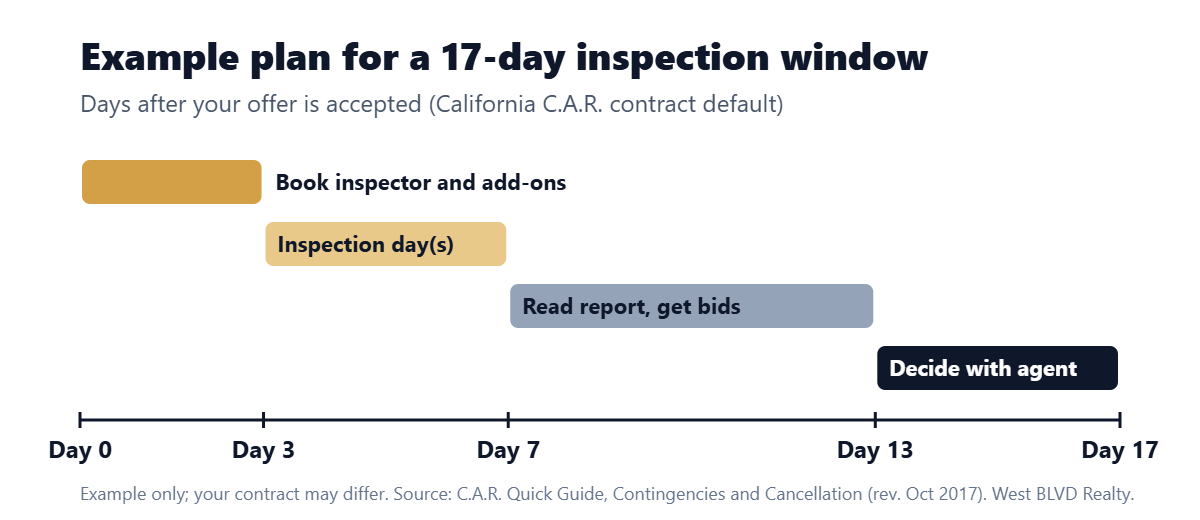
Once the report arrives, you’ll decide whether to move forward, ask for repairs or a credit, or cancel. In California Association of REALTORS® purchase agreements, the buyer’s investigation contingency runs 17 days by default, unless the contract sets a different number (C.A.R. Quick Guide). Check your own contract for your date.

Example timeline for a 17-day inspection window in a California home purchase
Example plan. The 17-day default comes from C.A.R. purchase agreements (C.A.R. Quick Guide, revised October 2017); your contract may set a different number.

A simple way to use those days:

  1. Book the home inspection and any add-ons in the first few days.
  2. Attend the inspection and take your notes and photos.
  3. Read the full report, and get repair bids for anything major.
  4. Talk with your agent about what to request, and decide before the deadline.

Repairs or credits affect your cash at closing, so it helps to know the closing costs buyers pay in Long Beach. If you’re still house hunting, our tips on making a competitive offer and our step-by-step home buying guide cover the steps before this one.

This is general information, not legal or inspection advice. Ask your agent, inspector or attorney how it applies to your purchase.

Frequently asked questions

Does the buyer attend the home inspection?

Usually, yes. The buyer hires the inspector, so buyers are welcome to attend. If you can’t stay the whole time, be there for the walk-through at the end, when the inspector explains the findings.

Do I need to bring tools to a home inspection?

No. The inspector brings the ladder, flashlight, testers and other equipment. Bring your phone, a way to take notes, a tape measure and your questions.

Should the seller be home during the inspection?

Sellers are often away during the buyer’s inspection. It gives the inspector room to work and lets you ask questions freely. If you’re selling, see how sellers prepare a home for inspection.

Is a termite inspection part of a home inspection in California?

No. In California, an opinion on termites and other wood-destroying pests has to come from an inspection by a licensed pest company. Ask your agent whether one has been ordered.

How long do I have to decide after the inspection?

It depends on your contract. In California Association of REALTORS® purchase agreements, the investigation contingency defaults to 17 days unless the contract sets a different number. Check your contract for your exact date.

Buying in Southern California?

We help buyers line up inspections, read the report and decide what to ask for before the deadline. See our buyer services or get in touch.

How to Buy a Home in Long Beach, CA: A 2026 Step-by-Step Guide

Updated November 19, 2026. Prices, rates and laws below are dated and linked where they’re used. Theary Pleng is a licensed California real estate broker (DRE #01958287) and mortgage broker (NMLS #1845778). This is a plain-English guide, not legal or tax advice.

Short answer: To buy a home in Long Beach, you get preapproved for a loan, sign a written buyer agreement with an agent, tour homes and make an offer on the California purchase contract. Then you open escrow, put down your deposit, do your inspections and read the seller’s disclosures, and close once your loan funds and the deed is recorded. In October 2026 the typical Long Beach home was worth $854,209, and a 30-year fixed loan averaged 7.28% in mid-November. That means a down payment of about $25,600 at 3% down or $170,800 at 20% down, plus closing costs.

What It Costs to Buy in Long Beach Right Now

MeasureLatest figureSource
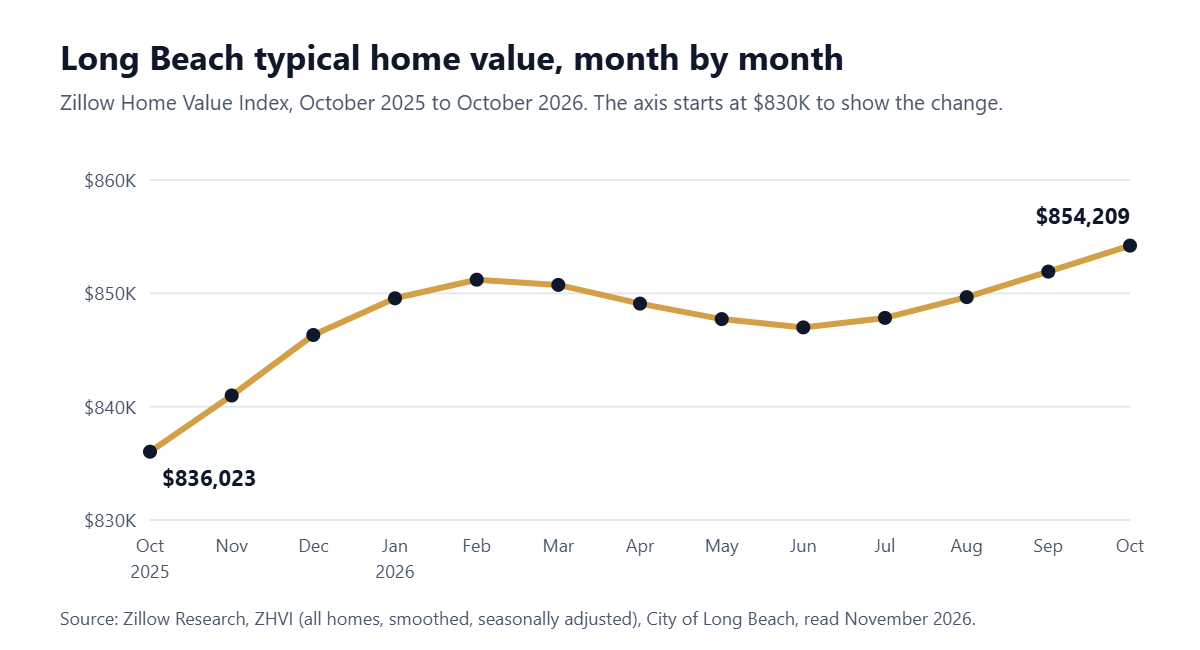
Typical home value$854,209 (up 2.2% in a year)Zillow Home Value Index, October 2026
Median sale price$889,381 (up 4.6% in a year)Redfin, October 2026
Median days on market51 daysRedfin, October 2026
Sale price vs. list price99.2%Redfin, October 2026
30-year fixed mortgage rate7.28% averageFreddie Mac, week of November 19, 2026
Loan limit (conventional and FHA)$1,249,125FHFA and HUD, 2026, Los Angeles County

Homes are selling close to their asking price but not overnight, which gives buyers time to inspect and negotiate. For the month-by-month numbers, see our Long Beach housing market report, and for the long view, Long Beach home prices since 2000.

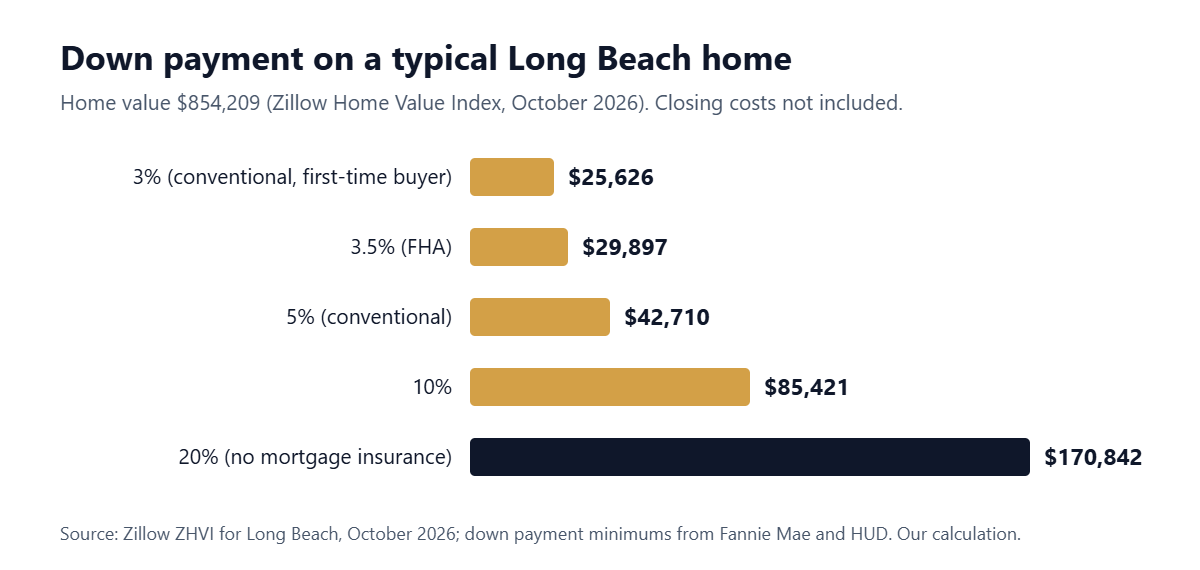
Here is the down payment alone on a home at the typical value of $854,209:

Bar chart of the down payment on a typical $854,209 Long Beach home at 3%, 3.5%, 5%, 10% and 20% down

On that home, principal and interest at 7.28% come to about $4,676 a month with 20% down, or about $5,739 with an FHA loan at 3.5% down. Property tax and insurance come on top. Our Long Beach mortgage guide has the full payment table for each loan type.

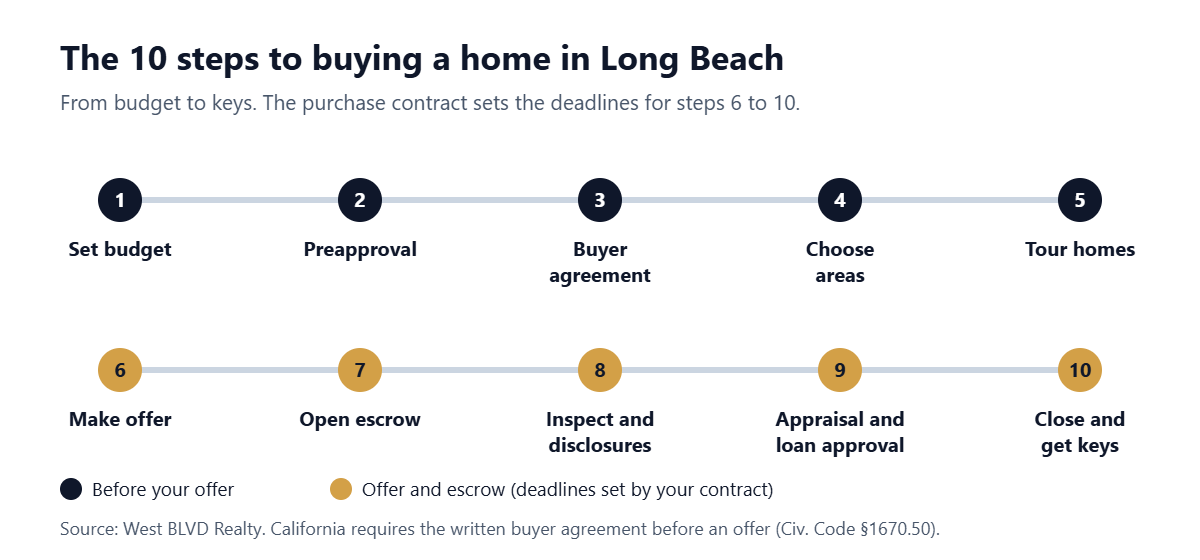
The 10 Steps to Buying a Home in Long Beach

StepWhat happensWho’s involved
1. Set your budgetAdd up savings, monthly debts and the payment you’re comfortable withYou
2. Get preapprovedA lender checks your credit, income and assets and names a loan amountLender or mortgage broker
3. Sign a buyer agreementCalifornia requires it in writing before you make an offerYou and your agent
4. Choose your areasNarrow down neighborhoods, school zones and commuteYou and your agent
5. Tour homesPrivate showings and open housesYou and your agent
6. Make an offerPrice, deposit, contingencies and closing date on the purchase contractYou, your agent, the seller
7. Open escrowA neutral escrow holder takes your deposit and runs the closingEscrow and title companies
8. Inspect and review disclosuresHome inspection, the seller’s disclosures, HOA documentsInspector, seller, your agent
9. Appraisal and loan approvalThe lender appraises the home and gives final approvalAppraiser, lender
10. Close and get the keysFinal walk-through, signing, funding and recordingEveryone
The 10 steps to buying a home in Long Beach, from setting a budget to closing and getting the keys

1. Set your budget

Start with cash, not price. You need the down payment, closing costs and some money left over for moving and repairs. Then decide on a monthly payment you’re comfortable with, including property tax, insurance and any HOA dues, not just the loan payment. California property tax starts at 1% of the price you pay (more on that below), so on $854,209 plan on at least about $712 a month before local add-ons.

2. Get preapproved

A preapproval is a lender’s written estimate of what you can borrow after checking your credit, income and assets. Most sellers want to see one with your offer. Compare at least two or three loan quotes; the rate, fees and mortgage insurance can differ a lot between lenders. If you’re a first-time buyer, ask about assistance programs at this stage, since some must be arranged through an approved lender. See what first-time buyer assistance is open in 2026; the City of Long Beach’s own grant has closed.

3. Sign a written buyer agreement

Since January 1, 2025, California requires a written agreement between you and your buyer’s agent, signed as soon as practicable and no later than when you sign an offer (Civ. Code §1670.50, from AB 2992). It must spell out:

  • How much the agent is paid, and when.
  • What services the agent provides.
  • How you or the agent can end it.

For individual buyers it can last at most 3 months and can’t renew automatically; any renewal must be in writing. Read it before you sign, and ask about anything you don’t understand.

4. Choose your areas

Long Beach runs from Belmont Shore and Naples by the water to Bixby Knolls, Los Altos and North Long Beach inland, and prices differ a lot by ZIP code. Our guide to the best neighborhoods in Long Beach for families compares typical values by ZIP and shows how to check school assignments by address. If Long Beach is a stretch, the nearby cities we serve are often worth a look:

5. Tour homes

Set up saved searches so new listings reach you the day they go live, and tour the best ones quickly. At each home, look past the staging: check the roof line, windows, water stains under sinks, the electrical panel and the age of the water heater and HVAC. Walk the street at night and at rush hour. Older Long Beach homes are common, so ask early about the age of the plumbing, sewer line and foundation, and about any added rooms and whether they were permitted.

6. Make an offer

Most California offers are written on the California Association of REALTORS® Residential Purchase Agreement. Your offer sets the price, your deposit, your loan terms, your contingencies (the conditions that let you cancel, such as inspection, appraisal and loan approval) and the closing date. Your agent will use recent sales to suggest a price; with homes selling at about 99% of list, most offers in Long Beach land near the asking price.

Your deposit (often called earnest money) can be kept by the seller if you back out without a contract reason, but California limits that. For a home of 1 to 4 units you plan to live in, a liquidated damages clause covering 3% of the price or less is presumed valid, and one over 3% is invalid unless the seller proves it’s reasonable (Civ. Code §1675). Read your contingency deadlines carefully: they are short, and missing one can put your deposit at risk.

7. Open escrow

Once your offer is accepted, escrow opens. The escrow holder is a neutral party that holds your deposit, collects the documents and money from both sides, and makes sure everything in the contract is done before closing. A title company searches the property’s records for liens and issues title insurance. Wire your deposit only after you confirm the escrow company’s instructions by phone, using a number you look up yourself; wire fraud targets home buyers.

8. Inspect and review disclosures

This is your chance to find problems before you’re committed. Hire a home inspector, and add specialists the inspector recommends (sewer scope, roof, termite, foundation). Our California home inspection checklist covers what to inspect and the rules inspectors follow, and what to bring to a home inspection helps you get the most out of the day.

At the same time, the seller delivers the disclosures California requires, including the Transfer Disclosure Statement and the Natural Hazard Disclosure. Read every page. Our guide to California seller disclosures explains each form and when a late disclosure lets you cancel. If the home is in an HOA, read the budget, reserves and any special assessments too.

9. Appraisal and loan approval

Your lender orders an appraisal to confirm the home is worth the price. If it comes in low, you can renegotiate, pay the difference in cash, or cancel if you still have an appraisal contingency. Then the lender gives final approval. Avoid new credit, big purchases and job changes until closing.

10. Close and get the keys

Do a final walk-through to check that the home is in the agreed condition and any agreed repairs are done. Then sign the loan and escrow documents, wire your remaining funds, and wait for the loan to fund and the deed to record with the county. Recording is when the home becomes yours.

In Los Angeles County, a documentary transfer tax of $1.10 per $1,000 of the price is due when the deed records (R&T Code §11911), about $940 on a $854,209 home. Your contract says who pays it. Some cities add their own tax, but Long Beach is not one of them:

City (LA County)City transfer tax on top of the county’s $1.10 per $1,000?
Long Beach, Lakewood, Bellflower, Carson, Cerritos, Norwalk, La MiradaNo
Culver CityYes: 0.45% of the price up to $1,499,999, with higher rates above that
City of Los AngelesYes: $2.25 per $500, plus extra tiers on sales of $5.4 million and up from July 1, 2026

Source: the LA County Registrar-Recorder’s list of city transfer taxes, read November 2026. For the rest of what buyers pay at closing, see closing costs in Long Beach.

After You Buy: Property Tax in California

Many first-time buyers are surprised by their property tax bills. Here’s how it works:

RuleWhat it means for youSource
Reassessment at purchaseYour home is reassessed to its value when you buy, usually the price you paidCal. Const. art. XIII A
1% base rateThe base tax is 1% of that value, plus local voter-approved bonds and assessmentsArt. XIII A, §1
2% yearly capThe assessed value can rise at most 2% a year while you own itArt. XIII A, §2
Supplemental tax billAn extra bill for the difference between the old and new value, prorated for the rest of the tax year. Buy between January and May and you get twoState Board of Equalization
Homeowners’ exemption$7,000 off your assessed value if it’s your main home on January 1. File form BOE-266 with the county assessor by February 15 for the full exemptionState Board of Equalization

The supplemental bill can arrive months after you move in. Ask your lender whether your loan’s impound account will pay it, and set money aside in case it won’t.

Tips for First-Time Buyers in Long Beach

  • Get your down payment documented early. Lenders want to see where the money came from, including any gift from family.
  • Price the whole payment. Condos and townhomes add HOA dues; older homes may need repairs soon after you move in.
  • Know what’s open for help. CalHFA’s programs and other options change through the year; our assistance guide tracks what’s open now.
  • Don’t skip contingencies to compete unless you fully understand what you’d lose if something goes wrong.
  • Keep every document. Your purchase contract, disclosures, inspection reports and closing statement matter when you sell, refinance or file taxes.

How West BLVD Realty Helps Buyers

Theary Pleng has helped buyers in Long Beach and nearby cities since 2014, as both a real estate broker and a licensed mortgage broker. That means one person can help you understand your loan options and your offer together. Through our buyer representation, we explain the buyer agreement in plain English before you sign, pull recent sales for every offer, track each contingency deadline, and walk you through inspections and disclosures. First-time buyers can start with our first-time homebuyer guidance.

FAQs

How long does it take to buy a house in Long Beach?

Plan on a few weeks to a few months to find the right home, then escrow on the timeline set in your purchase contract. Long Beach homes spent a median of 51 days on the market in October 2026 (Redfin), so you usually have time to tour and inspect.

How much do I need to buy a house in Long Beach?

On a home at the typical value of $854,209 (Zillow, October 2026), the down payment is about $25,600 at 3% down, $29,900 at 3.5% (FHA), $85,400 at 10% or $170,800 at 20%. You also need closing costs and some reserves.

Do I have to sign an agreement with a buyer’s agent in California?

Yes, if you work with one. Since January 1, 2025, California law requires a written buyer agreement no later than when you sign an offer. It must state how the agent is paid and can last at most 3 months for an individual buyer.

Does Long Beach have a transfer tax?

Long Beach has no city transfer tax. Los Angeles County’s documentary transfer tax of $1.10 per $1,000 applies, about $940 on a $854,209 home. Culver City and the City of Los Angeles add their own.

Start Your Long Beach Home Search

Ready to buy, or just want to know what you can afford? Contact West BLVD Realty or call (562) 537-5924. Theary will walk you through each step at your pace, with no pressure.

Long Beach First-Time Homebuyer Assistance: What’s Open in 2026

Updated November 19, 2026. Programs open and close often, so we check this page every month and link every rule to its source.

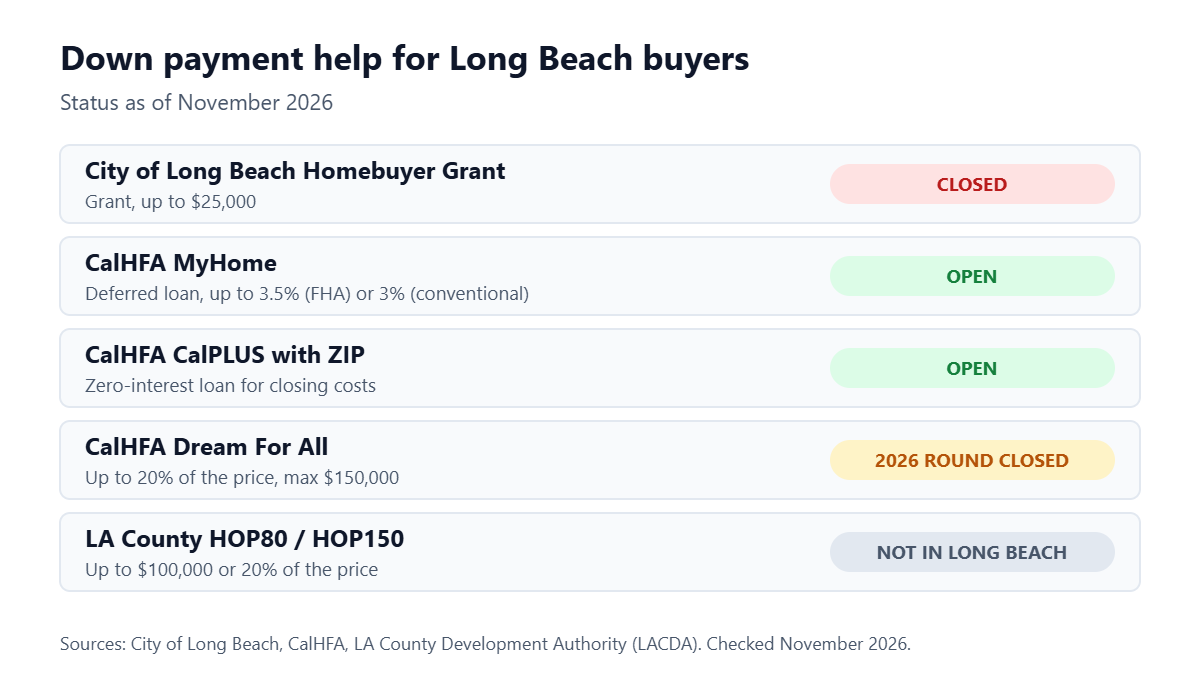
Short answer: the City of Long Beach’s $25,000 first-time homebuyer grant is closed. Its funds were used up after helping 76 households between March 2023 and September 2025. Long Beach buyers can still get help today. CalHFA’s MyHome loan covers up to 3.5% of the price, and CalHFA’s ZIP loan helps with closing costs. CalHFA’s Dream For All can cover up to 20%, but only when a new round opens. And if you buy in La Mirada or Culver City, the county’s HOP loan can cover up to $100,000.

Down Payment Assistance for Long Beach Buyers at a Glance (November 2026)

ProgramHelpStatusIncome limit
City of Long Beach First-Time Homebuyer AssistanceGrant, up to $25,000Closed: funds used upn/a
CalHFA MyHomeDeferred loan, up to 3.5% of the price (FHA) or 3% (conventional)Open, through approved lendersLA County $214,000; Orange County $274,000
CalHFA CalPLUS with ZIPZero-interest loan for closing costs, paired with a CalPLUS first mortgageOpen, through approved lendersCalHFA limits
CalHFA Dream For AllShared-appreciation loan, up to 20% of the price, maximum $150,0002026 round closed March 16, 2026; watch for the nextLA County $171,000; Orange County $219,000
LA County HOP80 / HOP1500% deferred loan, up to $100,000 or 20% of the price, whichever is lessOpen in participating cities only; Long Beach is not one4-person household: $133,250 (HOP80), $162,150 (HOP150)
Status of down payment programs for Long Beach buyers in November 2026: city grant closed, CalHFA MyHome and CalPLUS with ZIP open, Dream For All 2026 round closed, LA County HOP not available in Long Beach
Where each program stood in November 2026. Sources: City of Long Beach, CalHFA, LA County Development Authority.

CalHFA income limits effective June 30, 2026; Dream For All limits from CalHFA’s Dream For All income table; HOP limits effective August 24, 2026. Each program has more rules than fit in a table, so read the program page before you count on it.

What Happened to the City of Long Beach Homebuyer Grant?

From March 2023 to September 2025, the city’s First-Time Homebuyer Assistance Program gave $1.8 million in grants to 76 households. Grants were up to $25,000 toward a down payment and closing costs. The money has now been used, and the program is not taking applications. Many articles and agent pages still describe the $25,000 grant as if it were open. Most of them date from 2024.

To hear if the city funds a new round, join the city’s housing interest list at lbcd.info/housinglist. You can also reach the city’s Neighborhood Services Bureau at (562) 570-6949 or NSB@longbeach.gov. Source: City of Long Beach, First-Time Homebuyer Assistance Program. For other help, see the city’s homebuyer resources page, which lists CalHFA, HUD, homebuyer classes and nonprofit partners.

CalHFA MyHome: The Main Option Open Now

MyHome is a “silent second” loan from the California Housing Finance Agency. You make no monthly payment on it. You repay it when you sell, refinance or pay off your first mortgage.

  • How much: up to 3.5% of the purchase price or appraised value, whichever is less, with a CalHFA FHA first loan, or up to 3% with a CalHFA conventional loan.
  • Who qualifies: first-time homebuyers who will live in the home, within CalHFA’s income limit. For 2026 that is $214,000 in Los Angeles County and $274,000 in Orange County.
  • Education: one first-time buyer on the loan must finish a homebuyer course. The online option CalHFA accepts is eHome’s 8-hour course ($100). Classes from NeighborWorks or a HUD-approved counseling agency also count.
  • How to apply: CalHFA doesn’t lend directly. You apply through a CalHFA-approved loan officer.

On a $700,000 condo with a CalHFA FHA loan, 3.5% would be $24,500, about the size of the city’s old grant. Unlike the grant, it’s a loan you repay later.

CalPLUS and ZIP: Help With Closing Costs

CalHFA’s CalPLUS loans pair a first mortgage with the Zero Interest Program (ZIP), a deferred, zero-interest loan for closing costs. The trade-off is a first mortgage rate that CalHFA describes as “slightly higher” than its standard loan. The same income limits and education course apply. Ask a lender to compare the total cost both ways.

Dream For All: Up to 20%, When a Round Is Open

Dream For All is CalHFA’s largest program. It is a shared-appreciation loan for up to 20% of the price, to a maximum of $150,000. When you sell or refinance, you repay the loan plus a share of the home’s gain in value. It is for first-generation homebuyers, and funds go out by lottery in rounds. The 2026 round closed on March 16, 2026. Income limits are lower than MyHome: $171,000 in Los Angeles County and $219,000 in Orange County. If you might qualify, finish the homebuyer course and get pre-approved now, so you’re ready when CalHFA announces the next round.

LA County’s HOP Loan: For Nearby Cities, Not Long Beach

The Los Angeles County Development Authority’s HOP80 and HOP150 loans offer up to $100,000 or 20% of the price, whichever is less. They carry 0% interest, with repayment deferred and a share of the appreciation due when you sell. You must not have owned a home in the last three years. You apply only through a HOP participating lender.

HOP is limited to participating cities and unincorporated areas, and Long Beach is not on the list. Two cities we serve are: La Mirada and Culver City. If you’re open to buying there, HOP can be the biggest source of help on this page. Check the current list and price limits on the LACDA page before you shop.

FHA Loans in Long Beach

Many Long Beach first-time buyers use an FHA loan, which allows a down payment as low as 3.5% with a credit score of 580 or higher (HUD). CalHFA’s MyHome and ZIP are built to sit on top of an FHA loan. The trade-off is FHA mortgage insurance, which adds to the monthly payment. Compare it with a conventional loan before you choose.

How to Get Started

  1. Take the homebuyer course. CalHFA requires one. The city and county programs have required classes too. It’s good for planning either way.
  2. Talk to an approved lender. MyHome, ZIP and Dream For All go through CalHFA-approved loan officers. HOP goes through HOP participating lenders. Ask which programs they’re approved for.
  3. Get pre-approved with the program built in. Your offer should show the assistance, and it’s best to leave time for the program’s review in escrow.
  4. Shop with an agent who knows the rules. Programs have property, price and occupancy rules that affect which homes you can buy.

Broker Theary Pleng also holds a mortgage loan originator license (NMLS 1845778). She can help you compare programs and plan your purchase. Start with our first-time homebuyer guidance or buyer representation, and use our California home inspection checklist once you’re in escrow.

Frequently Asked Questions

Does the City of Long Beach have a first-time homebuyer program?

Not right now. The city’s grant of up to $25,000 helped 76 households from March 2023 to September 2025 and is closed because its funds were used up. Join the city’s interest list at lbcd.info/housinglist to hear about any new round.

What down payment assistance can I get in Long Beach today?

CalHFA’s MyHome loan (up to 3.5% with an FHA loan, or 3% with a conventional loan) and its ZIP closing-cost loan are open through approved lenders. Dream For All (up to 20%, maximum $150,000) opens in rounds; the 2026 round closed March 16, 2026.

What is the income limit for CalHFA in Los Angeles County?

For MyHome and CalHFA’s first mortgages, $214,000 in Los Angeles County and $274,000 in Orange County, effective June 30, 2026. Dream For All’s limits are lower: $171,000 and $219,000.

Can I use LA County’s HOP program in Long Beach?

No. Long Beach is not a HOP participating city. La Mirada and Culver City are, and HOP offers up to $100,000 or 20% of the price there.

Questions about which program fits you? Contact broker Theary Pleng at West BLVD Realty or call (562) 537-5924.

How to Make a Competitive Offer on a House in Long Beach (2026)

Updated November 19, 2026. Long Beach figures are from Redfin for October 2026; national figures are from NAR’s October 2026 survey.

A competitive offer in Long Beach isn’t just a higher price. It’s an offer the seller can trust to close: full pre-approval, a solid deposit, contingency periods the seller can live with, and a closing date that fits their plans. In today’s market, most homes sell close to the asking price, so terms often decide which offer wins.

This guide covers where the market stands, the five parts of an offer you can make stronger, which contingencies buyers are giving up, and one thing to leave out.

Where the Long Beach market stands

In October 2026 the median Long Beach home sold for $889,381, at 99.2% of its list price after a median 51 days on the market. 35.8% sold above list, and Redfin says Long Beach homes get about 2 offers on average (Redfin). The wider Los Angeles metro had 72% more sellers than buyers that month, which Redfin counts as a buyer’s market (Redfin, November 12, 2026).

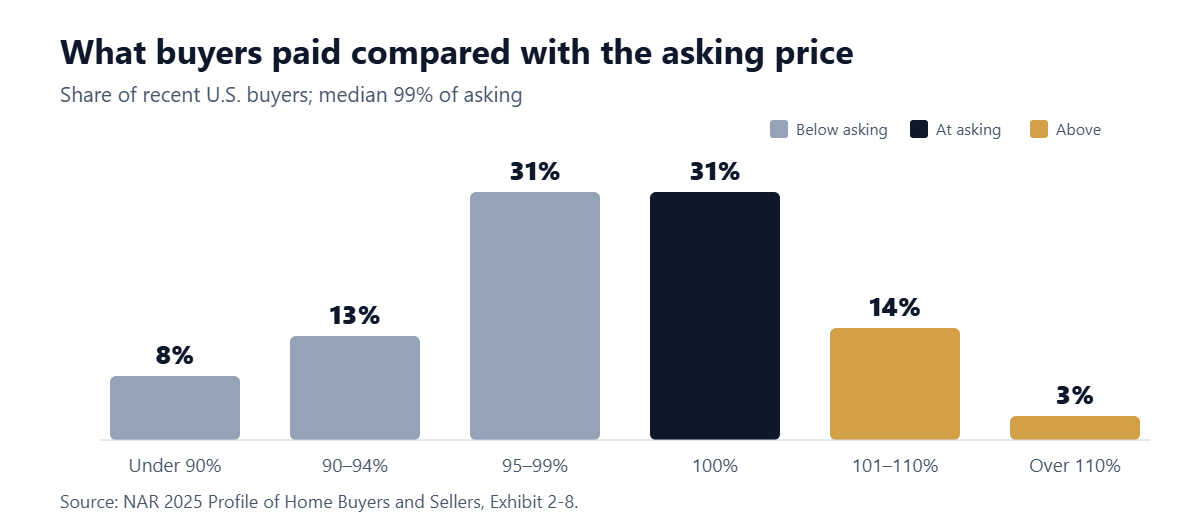
Nationally, competition has cooled too. In NAR’s October 2026 survey of agents, only 11% of homes sold above list, the lowest since NAR started asking in April 2021, and the most recent sale averaged 2.0 offers (NAR REALTORS® Confidence Index, November 12, 2026). Across a full year of sales, the typical buyer paid 99% of the asking price:

Bar chart: share of recent U.S. buyers by price paid compared with asking price, median 99%, from NAR 2025 Profile

So in most of Long Beach you aren’t bidding far over list. You’re competing with one or two other buyers, and the cleaner, more certain offer usually has the edge. Hot listings in popular neighborhoods are the exception; your agent’s read of the showings and offers on that home matters more than any average.

Before you write an offer

  • Get fully pre-approved, not just pre-qualified, so a lender has checked your income, assets and credit. Our mortgage guide covers 2026 loan limits and rates.
  • Have proof of funds ready for your deposit, down payment and closing costs.
  • Know your ceiling. Decide the most you’ll pay before you see the competition.

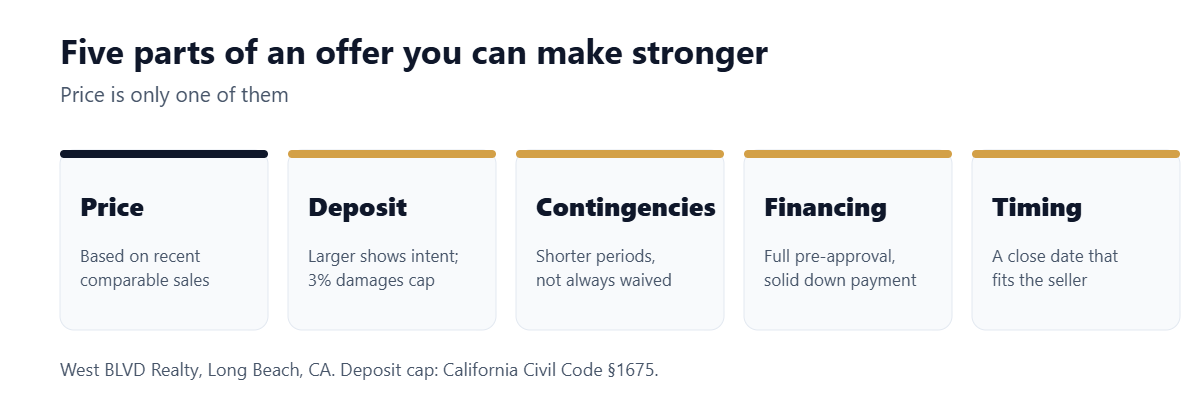
The five parts of an offer you can make stronger

Five parts of an offer you can make stronger: price, deposit, contingencies, financing and timing

1. Price

Start from recent comparable sales, not the list price. With homes selling near 99% of list, most offers land close to asking; go above it when the comps, the home’s condition and the competition support it. An escalation clause raises your price by a set amount over a competing offer, up to a cap you choose. The wording matters, so have your agent write it and set a cap you’re comfortable paying.

2. Deposit

Your deposit (often called earnest money) goes to escrow and shows the seller you’re committed. In California, if you’re buying a 1–4 unit home to live in, a liquidated damages clause of 3% of the price or less is presumed valid, and more than 3% is presumed invalid (Civil Code §1675). In practice, that means a deposit you might lose if you back out without a contract reason. Ask your agent how much to put down for the home you’re offering on.

3. Contingencies

Contingencies let you cancel if the inspection, appraisal or loan doesn’t work out. Some buyers waive them to compete: in NAR’s October 2026 survey, 19% of buyers waived the inspection contingency and 21% waived the appraisal contingency. Waiving one shifts the risk to you, so there are usually better options:

ContingencyWhat it protectsA stronger option than waiving
InspectionYour right to inspect and cancel over what you findShorten the period, or inspect before you offer when the seller allows it. If the seller has a pre-listing inspection, read it first.
AppraisalYour loan if the home appraises below your priceCommit to covering a set gap between the appraisal and the price, if you have the cash
LoanYour deposit if your financing falls throughFull pre-approval, a larger down payment, or a shorter loan period your lender confirms it can meet

Read our California home inspection checklist before you decide to shorten or give up an inspection.

4. Financing

Cash is still common: 29% of sales were all-cash in NAR’s October 2026 survey. You can’t match cash with a loan, but you can come close on certainty: a full pre-approval, a lender who will call the listing agent, and a down payment large enough that a small appraisal gap won’t sink the deal. First-time buyers can check our guide to down payment assistance in Long Beach.

5. Timing

Ask what the seller needs. A seller who’s buying their next home may want a longer escrow or a short rent-back after closing; an estate sale may want speed. Matching their timing costs you little and can beat a slightly higher offer.

Skip the “love letter”

Personal letters to sellers used to be common advice. NAR now warns against them because they can reveal things like race, religion or family status, which raises fair housing problems, and it advises sellers to decide on objective terms only (NAR Fair Housing Corner). Oregon passed a law banning them in 2021, but a federal court blocked it (Oregon Real Estate Agency). Put your effort into the terms instead.

Counteroffers and multiple offers

A seller may counter instead of accepting. In California, a counteroffer is a new offer, not an acceptance (Civil Code §1585), so you can accept it, counter back or walk away. With several offers, a seller may send counters to more than one buyer. Respond quickly, change only what matters, and don’t go past the ceiling you set.

If you lose, ask your agent for feedback on what won, and adjust price, terms or the homes you target.

How West BLVD Realty helps

When we represent buyers, we pull the comps, talk with the listing agent about what the seller values, and help you set price and terms before you write. For the whole process, see our step-by-step guide to buying a home in Long Beach. We help buyers across Long Beach, Cerritos and nearby cities.

Frequently asked questions

How much over asking should I offer in Long Beach?

Often none. Long Beach homes sold at 99.2% of list in October 2026, and 35.8% sold above list (Redfin). Go over asking only when recent comps and the competition on that home support it, and set your ceiling before you write.

How much earnest money do I need in California?

It depends on the home and the market, so ask your agent. Under Civil Code §1675, a liquidated damages amount of 3% of the price or less is presumed valid for a 1–4 unit home you’ll live in, and more than 3% is presumed invalid.

Should I waive contingencies to win?

Only if you understand the risk. Nationally, 19% of buyers waived the inspection contingency and 21% waived the appraisal contingency in October 2026 (NAR). Shorter contingency periods or an appraisal gap commitment often compete well without giving up your protection.

Should I write a letter to the seller?

No. NAR warns that personal letters can raise fair housing issues and advises sellers to choose offers on objective terms. A strong price, deposit and timeline say more.

This article is general information, not legal advice. Talk with your agent and, if needed, an attorney about your offer.

Ready to make an offer in Long Beach? Contact West BLVD Realty or call (562) 537-5924.

Closing Costs in Long Beach: What Buyers Pay and Who Pays What (2026)

Updated November 19, 2026. Every fee, rate and rule below is linked to its source. Theary Pleng is a licensed California real estate broker (DRE #01958287) and mortgage broker (NMLS #1845778). This is a plain-English guide, not legal or tax advice.

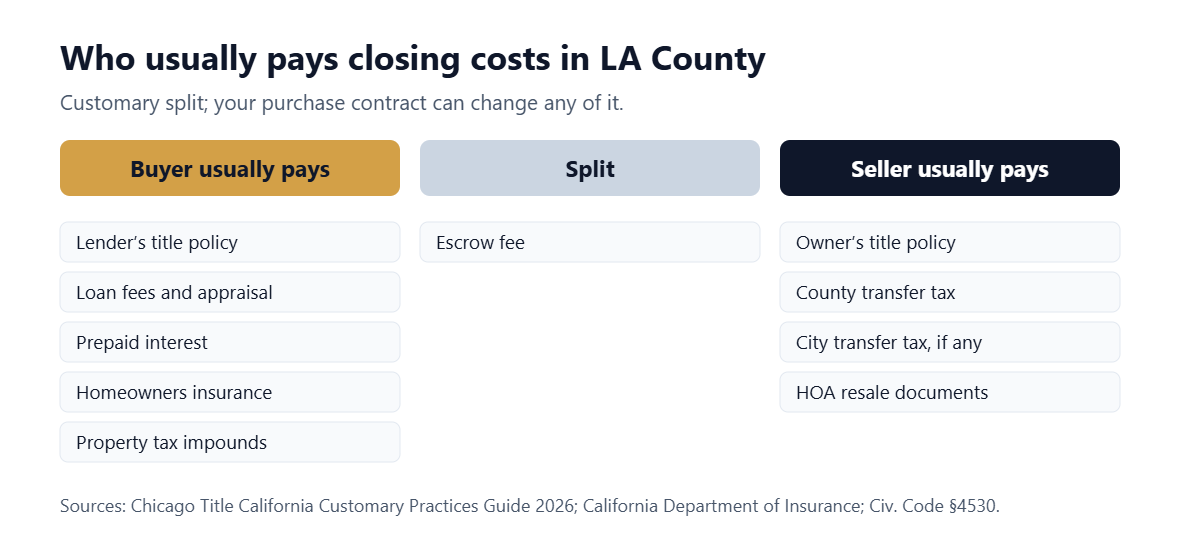
Short answer: In Los Angeles County, the buyer usually pays their loan costs, the lender’s title policy, half the escrow fee and prepaid items (interest, insurance and property tax). The seller usually pays the owner’s title policy, the county transfer tax and any city transfer tax. These are customs, not laws, and everything is negotiable in your purchase contract. On an $850,000 Long Beach home with a conventional loan, the lender’s title policy alone runs about $1,391 at one major insurer’s filed rates, and two weeks of prepaid interest can add another $2,000 or so.

How Much Are Buyer Closing Costs in California?

It depends on what you count. A widely quoted rule of thumb is 2% to 5% of the loan amount (Bankrate, November 2026). That range includes lender fees and prepaid items.

Counting only title, settlement and government charges, LodeStar’s 2025 data put California’s average at $5,577, or 0.75% of an average $747,854 sale price, cited by the same Bankrate article. That figure leaves out lender fees, discount points and prepaids, which is why real cash-to-close numbers are higher.

The best number is your own. Your lender must send a Loan Estimate within three business days of your application, and a five-page Closing Disclosure at least three business days before you close (CFPB; CFPB). Compare the two line by line.

Who Pays What in Long Beach and LA County

Here is the customary split in Los Angeles County, from Chicago Title’s 2026 California customary practices guide and the California Department of Insurance:

CostWho usually pays in LA CountySource
Escrow feeSplit between buyer and sellerChicago Title, 2026
Owner’s title insurance policySellerChicago Title, 2026; California Department of Insurance
Lender’s title insurance policyBuyerCalifornia Department of Insurance
County documentary transfer tax ($1.10 per $1,000)SellerChicago Title, 2026
City transfer tax (Culver City, City of Los Angeles)SellerChicago Title, 2026
HOA resale documentsSeller (the association bills the seller)Civ. Code §4530
Loan fees, appraisal, prepaid interest, insurance and tax impoundsBuyerYour Loan Estimate

Chicago Title notes that these terms are “deal-specific and negotiable.” Your purchase contract decides who pays, and in a slower market buyers can often ask the seller to cover more.

Chart of who usually pays closing costs in LA County: buyer, split and seller

The Buyer’s Costs, One by One

The example below uses an $850,000 home with a 20% down conventional loan of $680,000. That is close to Long Beach’s typical value of $854,209 (Zillow, October 2026), and it matches a price point on a published title rate sheet.

Buyer costExample on $850,000How it’s set
Lender’s title policy$1,391Old Republic Title’s Los Angeles rates, effective March 17, 2025, for an ALTA loan policy issued with the owner’s policy
Your half of the escrow feeVariesEach escrow company sets its own fee; ask for a written quote
Loan fees and appraisalVariesItemized on your Loan Estimate
Prepaid interestAbout $2,17016 days at 7.28% on $680,000 (closing mid-month); our calculation
First year of homeowners insuranceVariesOften paid in advance at closing (CFPB)
Property tax impoundsVariesBase tax of 1% is $8,500 a year, plus local voter-approved charges
Recording feesSmallLA County fee schedule

Title insurance

Title insurance protects against problems with the property’s ownership history. There are two policies: the owner’s policy protects you, and the lender’s policy protects your lender. Every title insurer must file its rates with the California Insurance Commissioner, and rates differ by company, so comparing can save money (California Department of Insurance). The premiums are paid once, at closing. Ask about discounts the Department lists, such as a short-term rate when a home is resold within five years and a reduced rate when both policies are issued together.

For reference, Old Republic Title’s filed Los Angeles rates (effective March 17, 2025) at $850,000 are $2,220 for a standard owner’s policy, $2,442 for the broader Homeowner’s Policy, and $1,391 for a lender’s policy issued with the owner’s policy. Endorsements, escrow and recording fees are extra.

Escrow fees

The escrow holder is the neutral party that holds the money, prepares documents, prorates taxes and insurance, records the deed and pays everyone at closing (California Department of Insurance). In Southern California, title and escrow are usually handled by separate companies. Independent escrow companies are licensed by the California Department of Financial Protection and Innovation. Fees vary by company, so ask for a quote before you open escrow. In LA County the fee is customarily split between buyer and seller.

Prepaid interest, insurance and property tax

Interest on your loan starts the day you close, and you prepay it from closing to the end of that month (CFPB). On a $680,000 loan at 7.28%, that’s about $136 a day. It’s also common to pay the first year’s homeowners insurance premium at closing.

Get insurance quotes early. The California FAIR Plan, the insurer of last resort for many homes, raised its rates an average of 29.1% starting October 15, 2026 (KQED, August 2026).

Property tax in LA County starts at 1% of your purchase price plus voter-approved debt for your area (LA County). After you buy, you’ll also get one or two supplemental tax bills for the difference between the old and new assessed value (State Board of Equalization). Our Long Beach home buying guide explains how property tax works after you buy.

Recording fees

The county charges to record your deed and deed of trust. The base fee for a grant deed is $15 for the first page plus $3 for each extra page, with small state add-on fees (LA County Registrar-Recorder). California’s $75 per-document housing fee (SB 2) does not apply to documents recorded in connection with a transfer that pays documentary transfer tax (Gov. Code §27388.1), which covers a normal home purchase.

Transfer Tax in Long Beach and Nearby Cities

Los Angeles County charges a documentary transfer tax of $1.10 per $1,000 of the price (R&T Code §11911), or $935 on an $850,000 home. By custom the seller pays it. Only five cities in the county add their own tax: Culver City, Los Angeles, Pomona, Redondo Beach and Santa Monica (LA County Registrar-Recorder, read November 2026). Long Beach is not on that list.

Where the home isTransfer tax on $850,000
Long Beach, Lakewood, Bellflower, Carson, Cerritos, Norwalk, La Mirada$935 county tax only
Culver City$935 county tax plus 0.45% city tax ($3,825)
Orange County cities we serve$935 county tax ($1.10 per $1,000, per Chicago Title’s 2026 guide)

Can the Seller Pay Your Closing Costs?

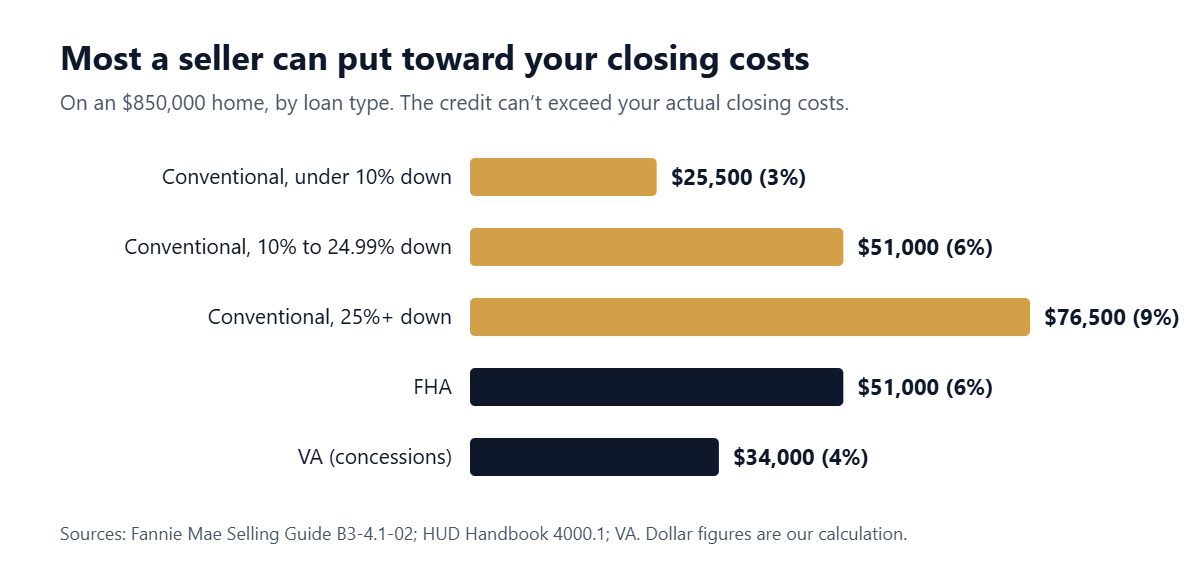
Yes, within limits set by your loan program. A seller credit can’t be more than your actual closing costs, and each program caps how much the seller can contribute:

Loan typeMost the seller can contributeOn $850,000
Conventional, less than 10% down3%$25,500
Conventional, 10% to 24.99% down6%$51,000
Conventional, 25% or more down9%$76,500
FHA6%$51,000
VA4% concessions (normal closing costs don’t count toward it)$34,000

Sources: Fannie Mae Selling Guide B3-4.1-02 (conventional limits are based on loan-to-value, and investment properties are capped at 2%); HUD Handbook 4000.1; VA. Dollar figures are our calculation.

Bar chart of the most a seller can contribute to closing costs on an $850,000 home by loan type

FHA and VA Loan Fees

Government-backed loans add one more fee at closing:

  • FHA: an upfront mortgage insurance premium of 1.75% of the base loan (HUD Mortgagee Letter 2023-05). On $850,000 with 3.5% down, that’s about $14,354.
  • VA: a funding fee of 2.15% for a first-time user with less than 5% down, 1.5% with 5% down and 1.25% with 10% down; 3.3% for later use with less than 5% down (VA). Veterans receiving VA disability compensation are exempt, and the fee can be financed into the loan. On $850,000 with no down payment, a first-time user pays about $18,275.

For loan types, rates and payments, see our Long Beach mortgage guide.

Help With Closing Costs

First-time buyers can use CalHFA programs for closing costs:

  • CalHFA MyHome: a deferred-payment loan of up to 3.5% (with a CalHFA FHA loan) or 3% (with a CalHFA conventional loan) of the price, for down payment and/or closing costs (CalHFA).
  • CalHFA Zero Interest Program (ZIP): paired with the CalPLUS FHA loan, which has a slightly higher rate, to cover closing costs (CalHFA).

Programs open and close during the year. Our first-time homebuyer assistance guide tracks what’s available now.

How to Lower Your Closing Costs

  • Compare title and escrow quotes. Rates are filed by each company and they differ.
  • Ask about title discounts, such as the short-term rate if the home sold within the last five years.
  • Negotiate a seller credit within your loan’s limit. Long Beach homes took a median of 51 days to sell in October 2026 (Redfin), which gives buyers room to ask.
  • Pick your closing date with prepaid interest in mind. Closing late in the month means fewer days of prepaid interest to bring to closing.
  • Check the Closing Disclosure against your Loan Estimate and ask about any fee that went up.

How West BLVD Realty Helps

Because Theary Pleng is both a broker and a licensed mortgage broker, she can walk you through your Loan Estimate, seller credit options and escrow costs together, before you write an offer. Through our buyer representation we negotiate who pays what in the contract, and first-time buyers can start with our first-time homebuyer guidance. For the full buying process, see our step-by-step guide to buying a home in Long Beach.

FAQs

Who pays closing costs in California?

Both sides pay some. In Los Angeles County the seller customarily pays the owner’s title policy and the transfer tax, the buyer pays the lender’s title policy and loan costs, and the escrow fee is split. Your purchase contract decides the final split.

How much are buyer closing costs in Long Beach?

A common estimate is 2% to 5% of the loan amount, including loan fees and prepaid items. On an $850,000 home, the buyer’s lender’s title policy is about $1,391 at Old Republic Title’s filed LA rates, and prepaid interest can add around $2,000. Your Loan Estimate gives your actual numbers.

Who pays escrow fees in California?

In Los Angeles and Orange counties, the escrow fee is customarily split between buyer and seller. Customs differ by county, and buyer and seller can agree to any split in the contract.

Can the seller pay my closing costs?

Yes, up to your loan program’s limit: 3% to 9% on conventional loans depending on your down payment, 6% on FHA and 4% in concessions on VA. The credit can’t be more than your actual closing costs.

Get a Closing Cost Estimate

Want to know your cash to close before you make an offer? Contact West BLVD Realty or call (562) 537-5924. Theary will go through the numbers with you, with no pressure.

How to Price Your House to Sell in Long Beach (2026 Guide)

Updated November 19, 2026. Market figures are for October 2026 unless noted.

To price your house to sell in Long Beach, start from what similar homes near you actually sold for in the last few months, adjust for the differences, check that figure against the homes you’ll be competing with right now, and pick a number a buyer’s appraiser can support. Then watch the first two to four weeks closely. National data shows the discount grows the longer a home sits, so a price that’s off is cheaper to fix early than late.

Below are the current Long Beach numbers, what overpricing costs by week, the research on how the exact list price affects offers, and the California rules on price opinions and appraisals.

The Long Beach market your price walks into

Your list price is judged against everything else for sale and everything that just sold. Here’s where Long Beach stood in October 2026, from Redfin’s Long Beach housing market data (all home types, from MLS and public records).

Measure (Long Beach, Oct 2026)FigureChange vs Oct 2025
Median sale price$889,381+4.6%
Median price per square foot$620+2.4%
Sale-to-list price ratio99.2%−0.27 points
Homes sold above list price35.8%−0.28 points
Homes sold with a price drop29.8%+1.0 point
Median days on market51Same
Homes sold in the month607674 a year earlier

Two things stand out. First, this is a balanced market, not a frenzy: Redfin rates Long Beach “somewhat competitive,” says the average home sells for about 1% below list and goes pending in about 52 days, while the hottest homes sell about 1% above list and go pending in about 27 days. Second, close to 3 in 10 homes that sold needed a price drop first. Zillow’s Long Beach home value index tells a similar story: $854,209 in October 2026, up 2.2% in a year.

For the longer view of prices across the 17 cities we serve, see our Long Beach home price history, and for month-by-month trends, the Long Beach housing market report.

What overpricing costs, week by week

The National Association of Realtors asks recent sellers how their sale price compared with their final list price. In the 2025 Profile of Home Buyers and Sellers (sales from July 2024 to June 2025), the answer depended on how long the home sat:

Time on marketSale price as % of final list price (median)
Less than 1 week100%
1 to 2 weeks100%
3 to 4 weeks99%
5 to 8 weeks98%
9 to 16 weeks96%
17 weeks or more94%
All sellers99%
Bar chart of median sale price as a percent of list price by weeks on market, from 100% under two weeks to 94% at 17 weeks or more

On a home at Long Beach’s $889,381 median, the gap between 99% and 94% is about $44,500 (our calculation). And that understates it, because NAR compares the sale price with the final list price, after any cuts. A home that sat for months usually came down from a higher first price too.

The pressure to cut is real right now. In the four weeks ending September 20, 2026, Redfin found 21.1% of U.S. sellers with active listings cut their price, the highest for that time of year in its records, and 16.5% in the Los Angeles metro, up 2.1 points (Redfin, September 30, 2026). Realtor.com counted 17.5% of active Los Angeles metro listings with a price reduction in October (Realtor.com October 2026 report).

The good news: NAR’s 2026 Profile (July 2025 to June 2026) found the median home sold in four weeks and 58% of sellers never reduced their price. Getting it right at the start is normal, not lucky.

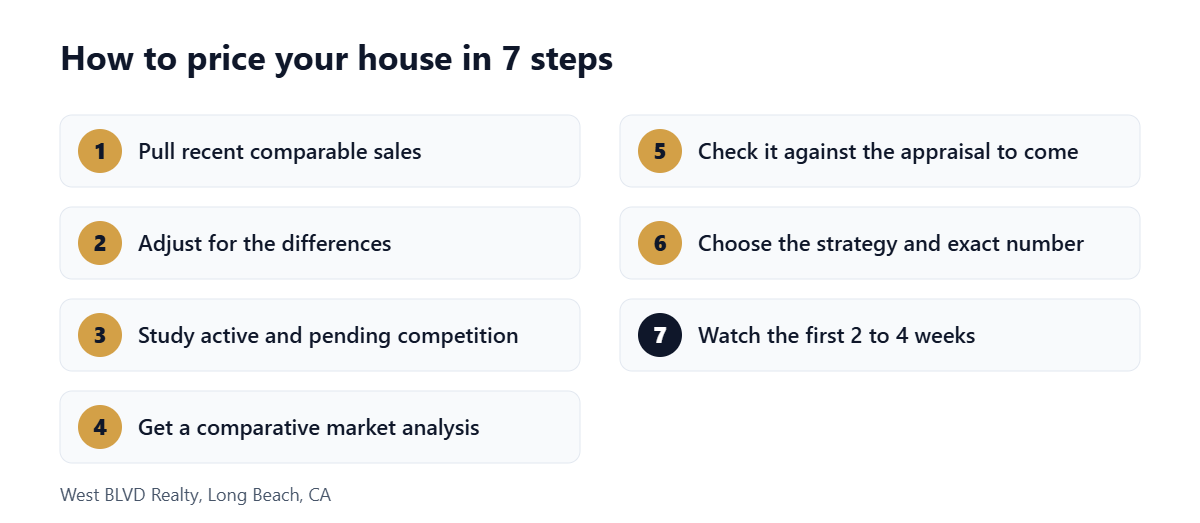
How to price your house in 7 steps

The 7 steps to price a house to sell, from comparable sales to watching the first weeks

1. Pull the right comparable sales

Comps are the closed sales a buyer, their agent and the appraiser will look at. Good comps are recent (ideally the last three to six months), close by (same neighborhood or ZIP, same side of any big dividing street), and similar in size, bedrooms, bathrooms, lot, age and condition. In Long Beach that matters more than usual: a Bixby Knolls ranch, a Belmont Shore condo and a North Long Beach starter home are different markets even within a few miles.

2. Adjust for the differences

No comp is a twin. Adjust up for what your home has that the comp didn’t (a remodeled kitchen, a garage, an extra bath, a bigger lot) and down for what it lacks. Price per square foot from comps is a quick check, not the answer: Long Beach’s median is $620 a square foot, but a condo, a duplex and a single-family home won’t share one number.

3. Study the competition you’ll list against

Sold comps show the past. Active and pending listings show the present: what buyers are choosing between this week. If three similar homes are sitting at $925,000 with price drops, listing at $949,000 tells buyers to wait for yours to drop too. If similar homes are going pending in under a month, you have more room.

4. Get a comparative market analysis

A comparative market analysis (CMA) puts steps 1 to 3 together in one report with a recommended price range. In California an agent can give you one without an appraiser license: Business and Professions Code §11302(b) says an appraisal “does not include an opinion given by a real estate licensee” in the course of their business, as long as it isn’t called an appraisal. West BLVD’s property valuation and CMA is free for Long Beach-area sellers.

5. Check the price against the appraisal to come

If your buyer finances, their lender will usually order an appraisal, and the loan is based on that value. Federal rules for national banks, for example, require a licensed or certified appraiser on most home loans above $400,000 (12 CFR 34.43). Fannie Mae can skip the appraisal through “value acceptance” for some loans, but not where the price or value is $1,000,000 or more (Fannie Mae Selling Guide B4-1.4-10), which covers many Long Beach homes. A price your comps can’t support may win an offer and then come apart at the appraisal, so stay inside the range the comps justify.

6. Choose your strategy and the exact number

Most sellers choose one of three approaches:

  • At market value: priced where the comps point. The default in a balanced market like Long Beach’s.
  • Slightly under market: meant to draw more showings and multiple offers. It works when demand is strong and your home shows well, but there’s no guarantee buyers bid it up.
  • Above market: “room to negotiate.” Per the NAR table above, this is the approach that tends to sit and sell at a discount.

Then pick the digits. The research here goes against some common advice. In a study of real home sales, Thomas, Simon and Kadiyali (Marketing Science, 2010) found buyers paid higher sale prices when list prices were more precise, such as $889,500 rather than $890,000. In a negotiation experiment, Cardella and Seiler (Journal of Economic Psychology, 2016) found a precise list price produced the highest final price and the smallest discount. And across more than 14,000 sales, Bucchianeri and Minson (2013) found higher starting prices were associated with higher selling prices, which is why the anchor matters, as long as it isn’t so high the home goes stale.

One practical limit: buyers search with a maximum price. A buyer whose search tops out at $900,000 never sees a home listed at $905,000, so check which side of a round number your price falls on.

7. Watch the first two to four weeks

Your listing gets the most attention when it’s new. Track showings, online saves, second showings and agent feedback. If you’re getting showings and no offers, buyers are telling you the price is ahead of the house. If you’re getting few showings, the price may be keeping you out of searches. NAR’s numbers say the discount starts to grow after about four weeks, so decide on any change with your agent by then, not after months.

Online estimate, CMA or appraisal?

EstimateWho makes itWhat it’s based onBest used for
Online estimate (Zestimate, Redfin Estimate)An algorithmPublic records and recent sales; nobody sees inside your homeA starting range
Comparative market analysisA licensed agentHand-picked comps, active and pending competition, your home’s conditionSetting the list price
AppraisalA licensed or certified appraiserAn inspection and comps under appraisal standardsThe lender’s loan decision; estates, divorces, disputes

How West BLVD Realty prices your home

Theary Pleng, broker, founded West BLVD Realty in 2014. Pricing is where most of the work happens before your home ever goes live:

  • A written CMA built from recent closed sales, current competition and a walk-through of your home.
  • A pricing plan that names the number, why, and what we’ll watch in the first weeks.
  • Prep that supports the price: staging, photos and the California seller disclosures done early so buyers trust what they see.
  • Full home seller representation from listing to close.

We price homes in Long Beach, Lakewood, Cerritos and the rest of our 17-city service area. For the full selling process, see our guide to selling your home.

Frequently asked questions

How much should I list my house for?

At the price recent comparable sales and current competition support, not the price you need or the highest online estimate. In Long Beach in October 2026 the median home sold for 99.2% of list, so a well-priced home should close near its asking price. A CMA from a local agent gives you the range.

How much above appraisal should I list my house?

Usually you won’t have an appraisal before listing; the buyer’s lender orders one after you accept an offer. If you list well above what comps support, the appraisal may come in low, and the lender lends on the lower value. Then the buyer pays the difference in cash, you renegotiate, or the deal may fall through, depending on your contract. Pricing within the comps avoids that.

Should I price my house below market to get multiple offers?

Sometimes. It can work for a home that shows well in a strong pocket, and about 36% of Long Beach homes sold above list in October 2026. But it’s a bet that buyers will compete, and in a balanced market they may not. Talk through your floor price before you choose it.

When should I reduce my price?

When the first weeks of showings and feedback say the price is the problem, generally before the four-week mark, when NAR’s data shows discounts start to grow. One well-judged cut usually beats several small ones that make buyers wait for the next.

Want a price you can trust? Contact West BLVD Realty or call (562) 537-5924 for a free comparative market analysis of your home.

Long Beach Mortgages and Financing: 2026 Rates, Loan Limits and Loan Types

Updated November 19, 2026. Rates, loan limits and fees below are from Freddie Mac, FHFA, HUD, the VA and Fannie Mae, each linked where it’s used. Theary Pleng is a licensed real estate broker (DRE #01958287) and mortgage broker (NMLS #1845778).

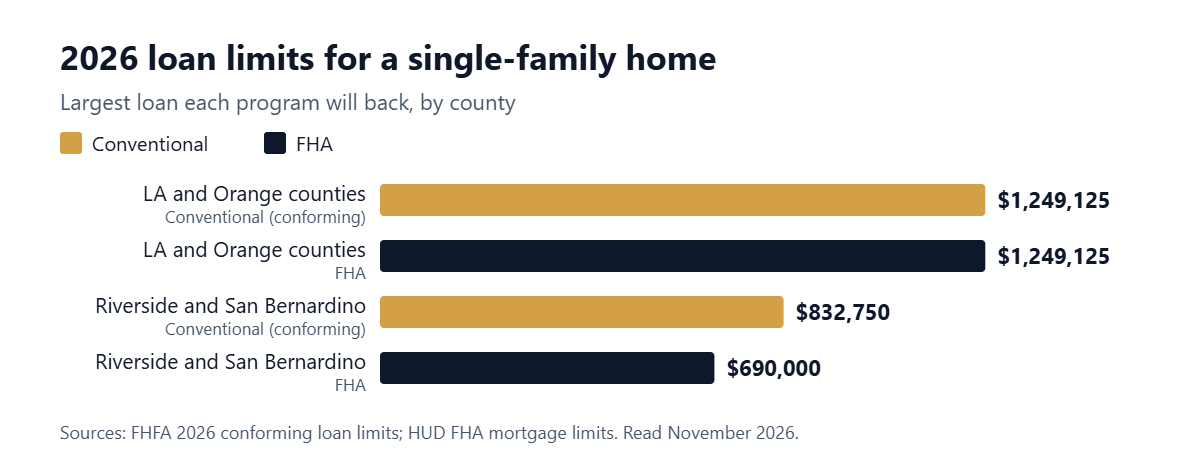
The short answer: most Long Beach buyers in 2026 finance with a conventional loan (3% to 20% down) or an FHA loan (3.5% down). In Los Angeles and Orange counties both programs go up to $1,249,125 for a single-family home, so a typical Long Beach house at about $854,000 fits under either limit. Veterans can use a VA loan with no down payment. Above $1,249,125 you need a jumbo loan. On Freddie Mac’s survey this week, the average 30-year fixed rate was 7.28%.

2026 Loan Limits for Long Beach and Nearby Cities

The loan limit is the largest loan a program will back in your county. It decides whether you can use a conventional or FHA loan, or need a jumbo. The 2026 limits for a one-unit home in the counties we serve:

CountyCities we serveConventional (conforming) limitFHA limit
Los AngelesLong Beach, Lakewood, Bellflower, Carson, Cerritos, Norwalk, La Mirada, Culver City$1,249,125$1,249,125
OrangeLa Palma, Buena Park, Cypress, Stanton, Fountain Valley, Brea$1,249,125$1,249,125
San BernardinoChino Hills, Redlands$832,750$690,000
RiversideRiverside$832,750$690,000

Sources: FHFA 2026 conforming loan limits (county list) and HUD FHA mortgage limits, both read November 2026. Limits are higher for 2- to 4-unit properties.

Bar chart of 2026 single-family loan limits: $1,249,125 conventional and FHA in LA and Orange counties; $832,750 conventional and $690,000 FHA in Riverside and San Bernardino
2026 loan limits for a one-unit home. Sources: FHFA and HUD.

Long Beach Mortgage Rates Right Now

Freddie Mac’s Primary Mortgage Market Survey is the standard weekly benchmark. For the week of November 19, 2026:

LoanThis weekLast weekA year ago
30-year fixed7.28%7.11%6.26%
15-year fixed6.66%6.45%5.54%

Source: Freddie Mac PMMS. These are national averages for buyers with strong credit and 20% down. Your own rate depends on your credit score, down payment, loan type, points and the day you lock, so compare actual quotes rather than headlines. The 30-year average is about a point higher than a year ago. For what’s happening to prices and sales, see our Long Beach housing market report.

Which Loan Fits a Long Beach Purchase?

LoanMinimum downMortgage insurance or feeGood fit for
Conventional3% if at least one buyer is a first-time buyer; otherwise usually 5%Private mortgage insurance below 20% down; it can be removed laterBuyers with solid credit; condos that aren’t FHA-approved
FHA3.5% with a 580+ credit score; 10% at 500–5791.75% upfront plus an annual premium (see below)Lower credit scores or higher debt; first-time buyers
VA0% for eligible veterans and service membersOne-time funding fee (2.15% on first use with under 5% down); some veterans are exemptVeterans, active duty, eligible surviving spouses
JumboSet by each lenderVaries by lenderLoans above $1,249,125 in LA and Orange counties

Sources: Fannie Mae 97% LTV options (a first-time buyer has not owned a home in the past three years), HUD FHA loans, VA funding fee. The VA funding fee drops to 1.5% with 5% down and 1.25% with 10% down, and is 3.3% on later uses with under 5% down. With full entitlement, the VA sets no loan limit.

FHA Loans in Long Beach

FHA is popular here because it allows a lower credit score and higher debt than most conventional loans. Two costs to plan for:

  • Upfront premium: 1.75% of the base loan, usually added to the loan.
  • Annual premium: paid monthly. Under HUD Mortgagee Letter 2023-05 it is 0.55% a year on base loans of $726,200 or less with under 5% down, and 0.75% on larger loans with under 5% down. With under 10% down it stays for the life of the loan, so many buyers refinance into a conventional loan once they have enough equity.

Condos: many Long Beach buyers start with a condo. An FHA loan on a condo needs the complex to be FHA-approved, or the single unit to qualify for a single-unit approval. Check the complex on HUD’s approved condominium list before you write an offer, and ask your agent to confirm with the HOA.

What the Monthly Payment Looks Like

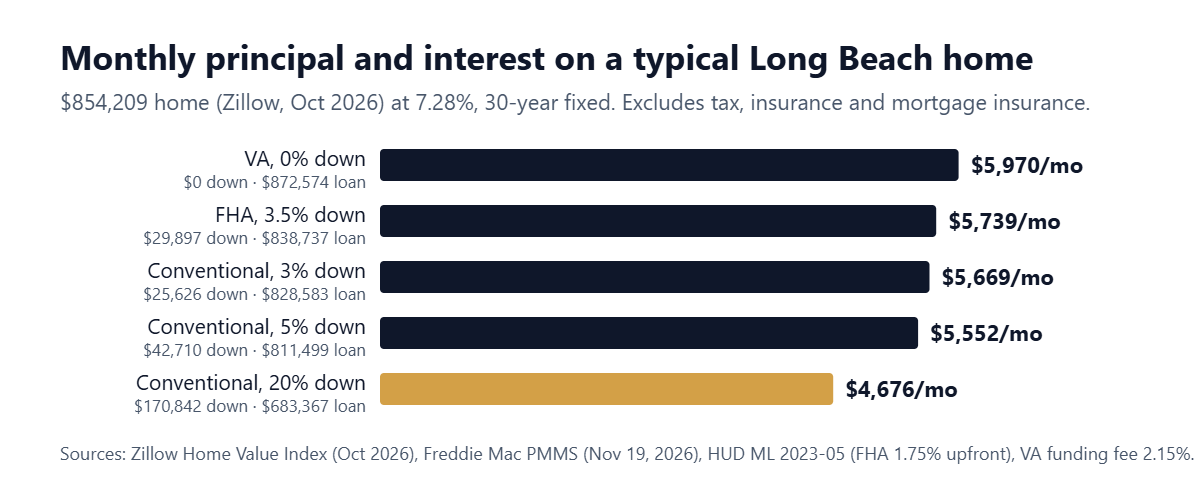
Here is the principal and interest on a home at Long Beach’s typical value of $854,209 (Zillow Home Value Index, October 2026), at this week’s 7.28% average for a 30-year fixed loan:

LoanDown paymentLoan amountPrincipal and interest a month
FHA, 3.5% down$29,897$838,737 (incl. $14,425 upfront premium)$5,739
Conventional, 3% down$25,626$828,583$5,669
Conventional, 5% down$42,710$811,499$5,552
Conventional, 20% down$170,842$683,367$4,676
VA, 0% down$0$872,574 (incl. $18,365 funding fee)$5,970

These figures are principal and interest only. Your full payment adds:

  • Property tax: California’s base rate is 1% of the purchase price (Proposition 13), plus local bonds and assessments. On $854,209, that’s at least about $712 a month.
  • Mortgage insurance: on the FHA example, about $515 a month at the start (0.75% a year). Conventional loans under 20% down add private mortgage insurance, priced by your credit and down payment.
  • Homeowners insurance and any HOA dues.
Bar chart of monthly principal and interest on an $854,209 Long Beach home at 7.28%: VA $5,970, FHA $5,739, conventional 3% down $5,669, 5% down $5,552, 20% down $4,676
Principal and interest only, on a $854,209 home at 7.28% (Freddie Mac, November 19, 2026). Home value: Zillow, October 2026.

Short on the down payment? See what’s open in 2026 in our guide to Long Beach first-time homebuyer assistance, and budget for closing costs on top.

Fixed Rate or Adjustable Rate?

A fixed-rate loan keeps the same interest rate, and the same principal and interest payment, for the whole term. An adjustable-rate mortgage (ARM) starts at a set rate for an opening period, often 5, 7 or 10 years, then adjusts on a schedule based on an index plus a margin, within caps written in your loan documents. See the CFPB’s comparison.

  • A fixed rate fits if you plan to stay well past the opening period or want a payment that never changes.
  • An ARM can fit if you expect to sell or refinance before the first adjustment. Ask the lender for the payment at the highest rate the caps allow, and make sure you could afford it.

Mortgage Broker or Bank?

A bank or retail lender offers its own loans. A mortgage broker compares loans from several wholesale lenders and helps you apply with the one that fits. West BLVD Realty is licensed for both sides of a purchase: Theary Pleng is a real estate broker (DRE #01958287) and a mortgage broker (NMLS #1845778). You’re never required to use your agent’s mortgage company; get at least two written Loan Estimates and compare the rate, points and lender fees line by line. You can look up any loan officer on NMLS Consumer Access.

How to Get Pre-Approved in Long Beach

  1. Check your credit and fix errors before you apply.
  2. Gather documents: two years of W-2s or tax returns, recent pay stubs, two months of bank statements and an ID. Self-employed buyers also need business returns.
  3. Apply with two or three lenders within a short window and compare the Loan Estimates.
  4. Get a written pre-approval for the price range you’re shopping. Sellers usually expect one with every offer.
  5. Don’t open new credit or move large sums until you close.

Then start your home search with a buyer’s agent; see our home buyer representation and, for a first purchase, first-time homebuyer guidance.

Refinancing and Building Equity

Refinancing replaces your loan with a new one, usually to lower the rate, drop FHA mortgage insurance, change the term or take cash out. It has closing costs, so work out how many months of savings it takes to cover them. Equity grows two ways: you pay down the loan each month, and the home’s value changes with the market. On a conventional loan, private mortgage insurance can be removed once you reach 20% equity under the loan’s terms. If you’re weighing a sale instead, ask us for a free comparative market analysis.

Frequently Asked Questions

What is the 2026 FHA loan limit in Long Beach?

$1,249,125 for a single-family home in Los Angeles County, which includes Long Beach. Orange County has the same limit. In Riverside and San Bernardino counties the FHA limit is $690,000.

How much do I need to put down on a house in Long Beach?

As little as 3% on a conventional loan if at least one buyer is a first-time buyer, 3.5% on an FHA loan with a 580+ credit score, or 0% on a VA loan. On a home at $854,209, that’s about $25,600 at 3% or $29,900 at 3.5%, plus closing costs.

What are mortgage rates in Long Beach today?

Freddie Mac’s weekly survey averaged 7.28% for a 30-year fixed loan and 6.66% for a 15-year fixed loan for the week of November 19, 2026. Your own rate depends on your credit, down payment and loan type.

Is a mortgage broker better than a bank?

A broker can compare several lenders at once; a bank offers only its own loans. Either can be the better deal, so compare written Loan Estimates from at least two sources.

Talk Through Your Financing

Want to know what you can buy in Long Beach and what the payment would be? Contact West BLVD Realty or call (562) 537-5924, and Theary will walk through your options with no pressure.

How Listings Work on the MLS and Portals: A Long Beach Guide (2026)

Updated November 19, 2026. Rules are from CRMLS and the National Association of REALTORS®; buyer figures are from NAR’s 2025 Profile of Home Buyers and Sellers. Each is linked below.

When you sell a home in Long Beach, your agent enters it in the Multiple Listing Service (MLS). From there it reaches other agents and, through data feeds, home search sites like Zillow, Realtor.com and Redfin, where most buyers start. The rules for how and when that happens changed a lot in 2024–2026. This guide explains how it works now and what your options are as a seller.

What the MLS is, and which one covers Long Beach

An MLS is a shared database where brokers list homes for sale and other brokers find homes for their buyers. Long Beach is covered by the California Regional MLS (CRMLS), which serves the Pacific West Association of REALTORS® among many other local associations (CRMLS). CRMLS says it serves more than 103,000 real estate professionals and is one of the three largest MLSs in the country (CRMLS, July 2025).

Only licensed brokers (and appraisers) can join CRMLS, so a homeowner can’t post a listing directly. Some brokers offer limited-service or “MLS entry-only” listings, where they enter the home and you handle the rest (CRMLS rules).

How a listing reaches buyers

Five steps of a Long Beach listing: listing agreement, entered in CRMLS within 1 business day of public marketing, agents see it, IDX and portal feeds, buyers find it
  1. You sign a listing agreement with a broker. CRMLS expects the listing in the MLS within 2 days of the agreement’s effective date.
  2. It goes into CRMLS. Under CRMLS’s Clear Cooperation rule, once a home is marketed to the public (a sign, a website or social post, flyers, an open house), it must be in the MLS within 1 business day. Entering it late can bring a fine of 1% of the list price, from $500 to $2,500 (CRMLS Clear Cooperation).
  3. Other agents see it and bring their buyers to see it.
  4. It shows up online. Through IDX, other brokers can show MLS listings on their own websites (NAR, IDX policy), and listing feeds send them to the big portals.
  5. Buyers find it. All buyers in NAR’s 2025 survey used the internet in their search.

Why that reach matters

Bar chart from NAR 2025: 52% of buyers found their home online, 27% through an agent, 9% through a friend, relative or neighbor, 12% other sources

52% of recent buyers found the home they bought online, and 27% through an agent (NAR 2025 Profile, Exhibit 3-6). 88% bought through an agent or broker.

Research backs this up. A study of 32,102 listings found that when MLS member agents viewed a listing more, it was more likely to sell, sold for slightly more and sold faster (Allen, Dare and Li, Journal of Real Estate Finance and Economics, 2018). Zillow found that homes sold off the MLS from 2023 to 2025 went for 1.3% less, about $4,230 per home (Zillow, May 2026); Zillow is a party in the private-listing debate, so weigh that.

Your listing options in CRMLS

OptionWhat it isMain rules
ActivePublic listing for MLS agents, broker websites and portalsThe standard listing. A brokerage can opt out of IDX and syndication at the office level.
Coming SoonIn the MLS before showings beginNeeds a form signed by the seller. No showings, including virtual ones. Up to 21 days, then it becomes Active. Days on market don’t count.
Office exclusive (“Registered”)Not marketed to the publicFor sellers who don’t want public marketing. Entered as Registered within 2 days, with the seller’s signed exclusion form. Any public marketing triggers the 1-business-day rule.
Limited service or MLS entry-onlyAn MLS listing with fewer broker servicesA broker enters the listing but provides fewer services; you handle the rest.

Sources: CRMLS Clear Cooperation and CRMLS rules. In 2025 NAR added a “delayed marketing” option that keeps a listing off portals for a period, but CRMLS chose not to adopt it (CRMLS, April 2025).

What changed since 2024

DateChange
August 17, 2024Offers of pay to buyers’ agents are no longer allowed on the MLS, and buyers’ agents need a written agreement before touring homes with a buyer (NAR). Sellers can still offer it outside the MLS.
January 1, 2025California requires a written buyer-broker agreement by the time the buyer makes an offer, for no more than 3 months (Civil Code §1670.50).
March 25, 2025NAR’s “Multiple Listing Options for Sellers” policy; the 1-business-day rule stays (NAR). CRMLS didn’t adopt the delayed marketing part.
April 10, 2025Zillow said it would not show listings that were marketed privately before going on the MLS (Zillow).
February 6, 2026A federal judge denied Compass’s request to block that Zillow rule (NAR).
March 17, 2026Zillow launched “Zillow Preview,” which lets brokerages show pre-market listings on Zillow (Zillow).

Commission is negotiable and isn’t set by the MLS or by law. Redfin reported the average buyer’s agent commission at 2.42% in the third quarter of 2025 (Redfin). Our guide to selling a house in Long Beach covers seller costs in full.

Getting the listing right

  • Price it from recent sales. See our pricing guide.
  • Use good photos and present the home well; our staging guide covers what buyers notice. In California, virtually staged photos must be disclosed.
  • Check every fact (square footage, beds, baths, lot) before it goes live, since portals copy it word for word.
  • Have disclosures ready so buyers’ agents can act quickly. See California seller disclosures and the pre-listing inspection guide.
  • Decide on Coming Soon or an office exclusive before you market anything, because a sign or a social post starts the 1-business-day clock.

How West BLVD Realty helps

As your listing broker, we enter your home in CRMLS, choose the right listing status with you, and make sure the details and photos are right before they spread to every portal. See our home seller representation and home valuation services.

Frequently asked questions

What MLS covers Long Beach?

The California Regional MLS (CRMLS), which serves the Pacific West Association of REALTORS® and many other associations. Listings entered there reach other agents, broker websites and the big home search sites.

Can I list my house on the MLS without an agent?

Not directly: only licensed brokers and appraisers can join CRMLS. Some brokers offer limited-service or MLS entry-only listings, where they enter your home and you handle showings and negotiation.

How fast does a listing have to go on the MLS?

In CRMLS, within 1 business day after any public marketing, such as a yard sign, website or social post, and within 2 days of the listing agreement. A Coming Soon listing can sit in the MLS for up to 21 days with no showings.

Does Zillow get every MLS listing?

Not always. Brokerages can opt out of IDX and syndication at the office level, and office exclusives aren’t marketed publicly. In March 2026 Zillow also added a “Preview” option for pre-market listings.

This article is general information. MLS rules and portal policies change; ask your agent for the current rules before you list.

Thinking about selling in Long Beach? Contact West BLVD Realty or call (562) 537-5924.

Long Beach Housing Market: 2026 Trends and 2027 Predictions

Updated November 17, 2026, with data through October 2026. We update this page every month.

Short answer: the Long Beach housing market is steady, not hot and not falling. The median sale price was about $889,000 over the three months ending October 2026, up 4.6% from a year earlier, and homes took about 51 days to sell, the same as last year. Fewer homes are selling (607 in October, down from 674), and mortgage rates are higher than a year ago (7.11% vs 6.24%). For 2027, the California Association of REALTORS® expects modest statewide price growth of 1.4% and slightly more sales.

Long Beach Housing Market at a Glance (October 2026)

MeasureLatestA year earlierSource
Median sale price (3 months ending Oct 2026)$889,381+4.6% year over yearRedfin
Median price per square foot$620+2.4% year over yearRedfin
Typical home value (Zillow Home Value Index)$854,209$836,023 (+2.2%)Zillow Research
Median days on market51 days51 daysRedfin
Sale-to-list price99.2%down 0.27 pointsRedfin
Homes sold in October607674 (−9.9%)Redfin
30-year fixed mortgage rate (U.S. average, Nov 12, 2026)7.11%6.24%Freddie Mac

Why two price figures? Redfin’s median is the middle price of the homes that actually sold, so it moves with the mix of homes on the market. Zillow’s index estimates the value of a typical Long Beach home whether it sold or not, so it moves more slowly. Both point the same way: prices are up modestly from a year ago.

Long Beach Home Values, Month by Month

Zillow Home Value Index for the city of Long Beach (all home types, middle price tier, smoothed and seasonally adjusted).

MonthTypical home value
October 2025$836,023
November 2025$840,982
December 2025$846,324
January 2026$849,558
February 2026$851,200
March 2026$850,743
April 2026$849,096
May 2026$847,726
June 2026$846,998
July 2026$847,831
August 2026$849,670
September 2026$851,914
October 2026$854,209
Line chart of Long Beach typical home value by month, from $836,023 in October 2025 to $854,209 in October 2026
Long Beach’s typical home value went from $836,023 in October 2025 to $854,209 in October 2026. Source: Zillow Home Value Index.

Values rose through the winter, eased slightly over the spring and summer, and reached a new high in October. The whole range over 13 months is under $20,000, which is a flat-to-rising market, not a boom.

Prices Vary a Lot by Neighborhood

A citywide figure hides big differences. In October 2026, Zillow’s typical value ranged from about $480,000 in ZIP code 90802 (downtown, mostly condos) to about $1.33 million in 90803 (Belmont Shore and Naples). East Long Beach ZIP codes 90808 and 90815 were just over $1 million, and Bixby Knolls (90807) was about $955,000. See every ZIP code in our guide to the best neighborhoods in Long Beach.

Long Beach Housing Market Predictions for 2027

No one publishes a forecast for Long Beach alone that we can stand behind, so here is what the main statewide forecast says, and how Long Beach compares.

  • Prices: C.A.R. forecasts the California median price for existing single-family homes to rise 1.4% in 2027, to $894,400, after a projected 0.8% rise in 2026.
  • Sales: statewide sales are forecast to rise 3.7% in 2027, after a projected 1.1% dip in 2026.
  • Rates: C.A.R. expects the 30-year fixed rate to average 6.6% in 2027.
  • Supply: C.A.R. expects a continued shortage of homes for sale to support prices while limiting how fast the market grows.

Source: C.A.R. 2027 California Housing Market Forecast, October 7, 2026. Long Beach’s recent price gain (Redfin’s 4.6% year over year) is running ahead of C.A.R.’s projected 0.8% for California in 2026. A forecast is not a promise; rates and the job market can change it quickly.

What This Means for Buyers

  • You have time to decide. At about 51 days on market, most homes aren’t gone in a weekend. Use the time for inspections and disclosures.
  • There is room to negotiate on many homes. The typical home sold for about 1% below list price, according to Redfin. Well-priced, updated homes still sell faster and above list, so price your offer from recent comparable sales, not the list price.
  • Rates matter more than price swings. On an $800,000 loan, each 1 point of interest rate changes the monthly principal and interest payment on a 30-year loan by roughly $525 to $550 at today’s rates. Get pre-approved and compare loan options before you shop. Theary also holds a mortgage loan originator license (NMLS 1845778) and can walk you through the numbers.

Start with buyer representation or, for a first purchase, first-time homebuyer guidance.

What This Means for Sellers

  • Prices are holding, but buyers are choosier. With fewer sales and rates above 7%, overpriced homes sit. Pricing right at the start matters more than in 2021 or 2022.
  • Condition shows up in the price. In a 51-day market, buyers compare. Fixing what an inspector will find avoids credits and escrow delays.
  • Know your home’s number. Citywide medians don’t price your street. A free comparative market analysis uses recent sales near you.

See seller representation.

Frequently Asked Questions

Is the Long Beach housing market going down?

No. The median sale price was up 4.6% year over year for the three months ending October 2026 (Redfin), and Zillow’s typical home value reached $854,209 in October, up 2.2% from a year earlier. Sales volume is lower, which means fewer homes are trading, not that prices are falling.

What is the median home price in Long Beach, CA?

About $889,000 for homes sold in the three months ending October 2026, according to Redfin. Zillow puts the typical home value at $854,209.

Is Long Beach a buyer’s or seller’s market?

Close to balanced. Homes take about 51 days to sell and typically go for about 1% below list price, while the best-priced homes still draw multiple offers.

Will home prices drop in Long Beach in 2027?

The main statewide forecast, from C.A.R., expects California prices to rise 1.4% in 2027. Local prices could still dip if mortgage rates rise or the job market weakens, so watch the monthly numbers on this page.

Questions about buying or selling in this market? Contact broker Theary Pleng at West BLVD Realty or call (562) 537-5924.