

Updated November 19, 2026. Every fee, rate and rule below is linked to its source. Theary Pleng is a licensed California real estate broker (DRE #01958287) and mortgage broker (NMLS #1845778). This is a plain-English guide, not legal or tax advice.
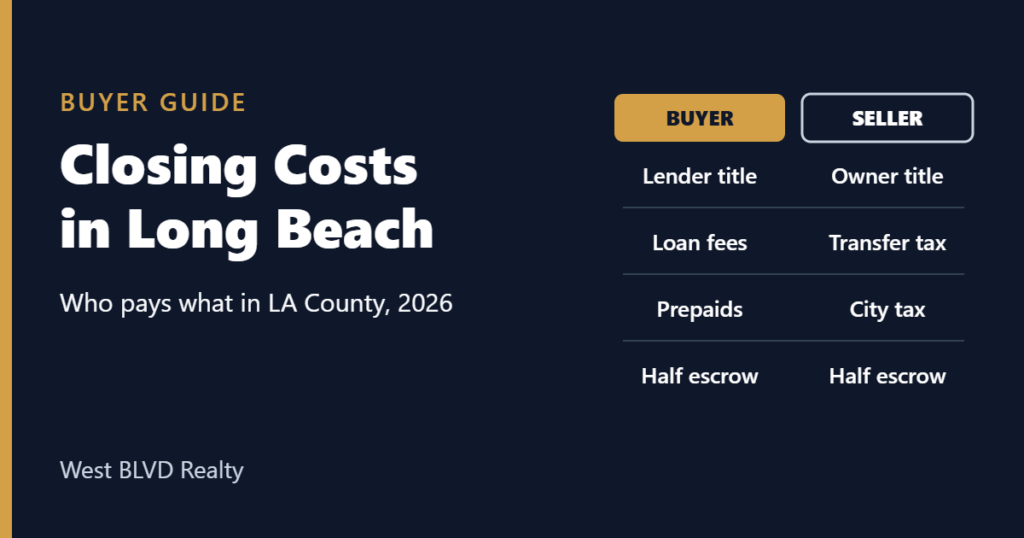
Short answer: In Los Angeles County, the buyer usually pays their loan costs, the lender’s title policy, half the escrow fee and prepaid items (interest, insurance and property tax). The seller usually pays the owner’s title policy, the county transfer tax and any city transfer tax. These are customs, not laws, and everything is negotiable in your purchase contract. On an $850,000 Long Beach home with a conventional loan, the lender’s title policy alone runs about $1,391 at one major insurer’s filed rates, and two weeks of prepaid interest can add another $2,000 or so.
How Much Are Buyer Closing Costs in California?
It depends on what you count. A widely quoted rule of thumb is 2% to 5% of the loan amount (Bankrate, November 2026). That range includes lender fees and prepaid items.
Counting only title, settlement and government charges, LodeStar’s 2025 data put California’s average at $5,577, or 0.75% of an average $747,854 sale price, cited by the same Bankrate article. That figure leaves out lender fees, discount points and prepaids, which is why real cash-to-close numbers are higher.
The best number is your own. Your lender must send a Loan Estimate within three business days of your application, and a five-page Closing Disclosure at least three business days before you close (CFPB; CFPB). Compare the two line by line.
Who Pays What in Long Beach and LA County
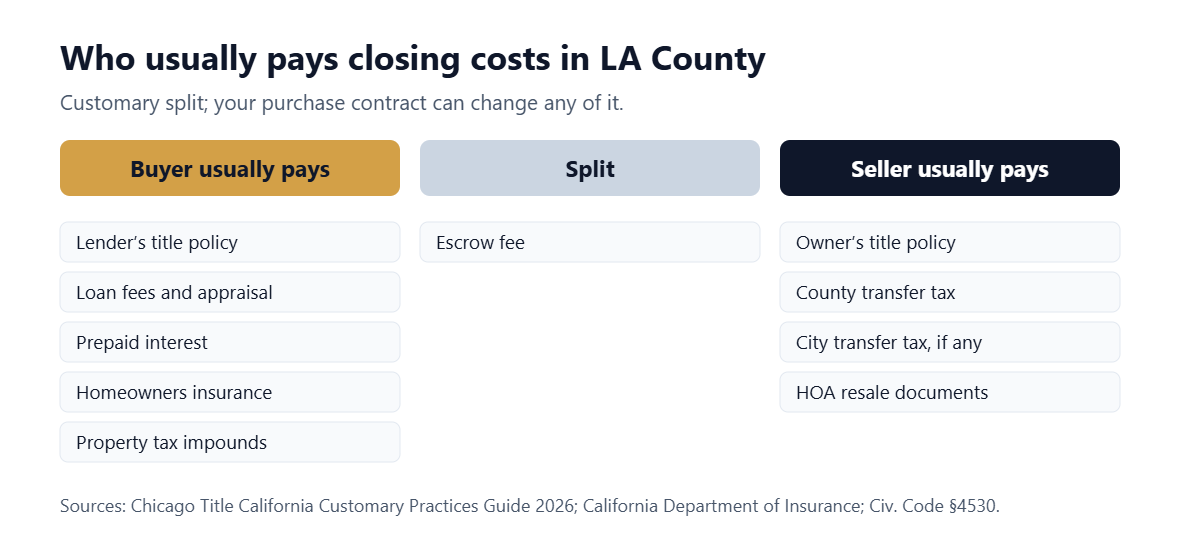
Here is the customary split in Los Angeles County, from Chicago Title’s 2026 California customary practices guide and the California Department of Insurance:
| Cost | Who usually pays in LA County | Source |
|---|---|---|
| Escrow fee | Split between buyer and seller | Chicago Title, 2026 |
| Owner’s title insurance policy | Seller | Chicago Title, 2026; California Department of Insurance |
| Lender’s title insurance policy | Buyer | California Department of Insurance |
| County documentary transfer tax ($1.10 per $1,000) | Seller | Chicago Title, 2026 |
| City transfer tax (Culver City, City of Los Angeles) | Seller | Chicago Title, 2026 |
| HOA resale documents | Seller (the association bills the seller) | Civ. Code §4530 |
| Loan fees, appraisal, prepaid interest, insurance and tax impounds | Buyer | Your Loan Estimate |
Chicago Title notes that these terms are “deal-specific and negotiable.” Your purchase contract decides who pays, and in a slower market buyers can often ask the seller to cover more.
The Buyer’s Costs, One by One
The example below uses an $850,000 home with a 20% down conventional loan of $680,000. That is close to Long Beach’s typical value of $854,209 (Zillow, October 2026), and it matches a price point on a published title rate sheet.
| Buyer cost | Example on $850,000 | How it’s set |
|---|---|---|
| Lender’s title policy | $1,391 | Old Republic Title’s Los Angeles rates, effective March 17, 2025, for an ALTA loan policy issued with the owner’s policy |
| Your half of the escrow fee | Varies | Each escrow company sets its own fee; ask for a written quote |
| Loan fees and appraisal | Varies | Itemized on your Loan Estimate |
| Prepaid interest | About $2,170 | 16 days at 7.28% on $680,000 (closing mid-month); our calculation |
| First year of homeowners insurance | Varies | Often paid in advance at closing (CFPB) |
| Property tax impounds | Varies | Base tax of 1% is $8,500 a year, plus local voter-approved charges |
| Recording fees | Small | LA County fee schedule |
Title insurance
Title insurance protects against problems with the property’s ownership history. There are two policies: the owner’s policy protects you, and the lender’s policy protects your lender. Every title insurer must file its rates with the California Insurance Commissioner, and rates differ by company, so comparing can save money (California Department of Insurance). The premiums are paid once, at closing. Ask about discounts the Department lists, such as a short-term rate when a home is resold within five years and a reduced rate when both policies are issued together.
For reference, Old Republic Title’s filed Los Angeles rates (effective March 17, 2025) at $850,000 are $2,220 for a standard owner’s policy, $2,442 for the broader Homeowner’s Policy, and $1,391 for a lender’s policy issued with the owner’s policy. Endorsements, escrow and recording fees are extra.
Escrow fees
The escrow holder is the neutral party that holds the money, prepares documents, prorates taxes and insurance, records the deed and pays everyone at closing (California Department of Insurance). In Southern California, title and escrow are usually handled by separate companies. Independent escrow companies are licensed by the California Department of Financial Protection and Innovation. Fees vary by company, so ask for a quote before you open escrow. In LA County the fee is customarily split between buyer and seller.
Prepaid interest, insurance and property tax
Interest on your loan starts the day you close, and you prepay it from closing to the end of that month (CFPB). On a $680,000 loan at 7.28%, that’s about $136 a day. It’s also common to pay the first year’s homeowners insurance premium at closing.
Get insurance quotes early. The California FAIR Plan, the insurer of last resort for many homes, raised its rates an average of 29.1% starting October 15, 2026 (KQED, August 2026).
Property tax in LA County starts at 1% of your purchase price plus voter-approved debt for your area (LA County). After you buy, you’ll also get one or two supplemental tax bills for the difference between the old and new assessed value (State Board of Equalization). Our Long Beach home buying guide explains how property tax works after you buy.
Recording fees
The county charges to record your deed and deed of trust. The base fee for a grant deed is $15 for the first page plus $3 for each extra page, with small state add-on fees (LA County Registrar-Recorder). California’s $75 per-document housing fee (SB 2) does not apply to documents recorded in connection with a transfer that pays documentary transfer tax (Gov. Code §27388.1), which covers a normal home purchase.
Ready to Buy or Sell in Southern California?
Transfer Tax in Long Beach and Nearby Cities
Los Angeles County charges a documentary transfer tax of $1.10 per $1,000 of the price (R&T Code §11911), or $935 on an $850,000 home. By custom the seller pays it. Only five cities in the county add their own tax: Culver City, Los Angeles, Pomona, Redondo Beach and Santa Monica (LA County Registrar-Recorder, read November 2026). Long Beach is not on that list.
| Where the home is | Transfer tax on $850,000 |
|---|---|
| Long Beach, Lakewood, Bellflower, Carson, Cerritos, Norwalk, La Mirada | $935 county tax only |
| Culver City | $935 county tax plus 0.45% city tax ($3,825) |
| Orange County cities we serve | $935 county tax ($1.10 per $1,000, per Chicago Title’s 2026 guide) |
Can the Seller Pay Your Closing Costs?
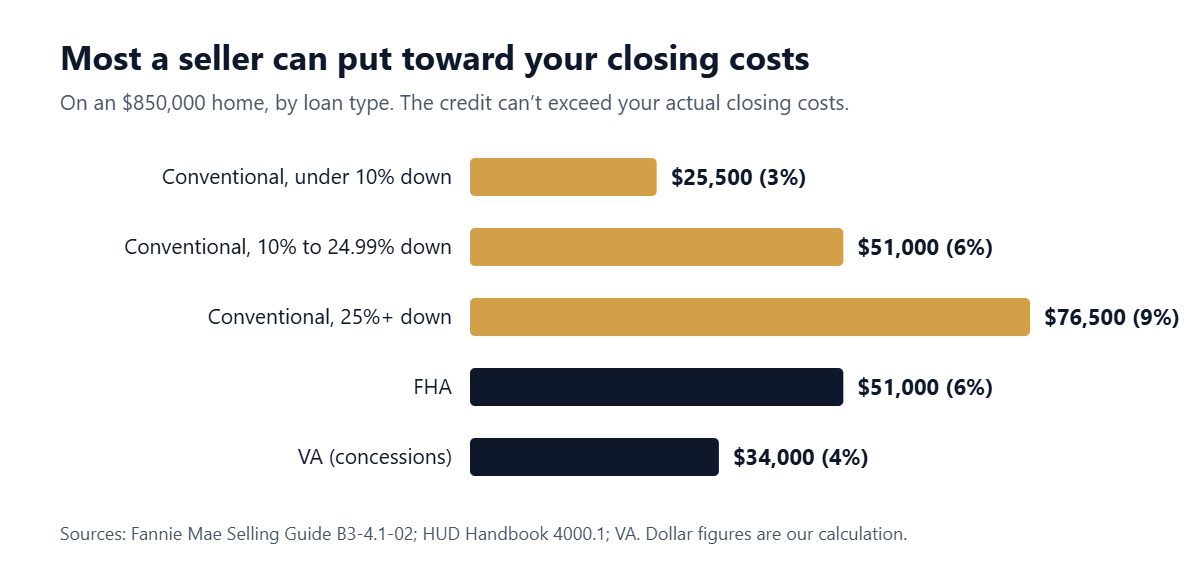
Yes, within limits set by your loan program. A seller credit can’t be more than your actual closing costs, and each program caps how much the seller can contribute:
| Loan type | Most the seller can contribute | On $850,000 |
|---|---|---|
| Conventional, less than 10% down | 3% | $25,500 |
| Conventional, 10% to 24.99% down | 6% | $51,000 |
| Conventional, 25% or more down | 9% | $76,500 |
| FHA | 6% | $51,000 |
| VA | 4% concessions (normal closing costs don’t count toward it) | $34,000 |
Sources: Fannie Mae Selling Guide B3-4.1-02 (conventional limits are based on loan-to-value, and investment properties are capped at 2%); HUD Handbook 4000.1; VA. Dollar figures are our calculation.
FHA and VA Loan Fees
Government-backed loans add one more fee at closing:
- FHA: an upfront mortgage insurance premium of 1.75% of the base loan (HUD Mortgagee Letter 2023-05). On $850,000 with 3.5% down, that’s about $14,354.
- VA: a funding fee of 2.15% for a first-time user with less than 5% down, 1.5% with 5% down and 1.25% with 10% down; 3.3% for later use with less than 5% down (VA). Veterans receiving VA disability compensation are exempt, and the fee can be financed into the loan. On $850,000 with no down payment, a first-time user pays about $18,275.
For loan types, rates and payments, see our Long Beach mortgage guide.
Help With Closing Costs
First-time buyers can use CalHFA programs for closing costs:
- CalHFA MyHome: a deferred-payment loan of up to 3.5% (with a CalHFA FHA loan) or 3% (with a CalHFA conventional loan) of the price, for down payment and/or closing costs (CalHFA).
- CalHFA Zero Interest Program (ZIP): paired with the CalPLUS FHA loan, which has a slightly higher rate, to cover closing costs (CalHFA).
Programs open and close during the year. Our first-time homebuyer assistance guide tracks what’s available now.
How to Lower Your Closing Costs
- Compare title and escrow quotes. Rates are filed by each company and they differ.
- Ask about title discounts, such as the short-term rate if the home sold within the last five years.
- Negotiate a seller credit within your loan’s limit. Long Beach homes took a median of 51 days to sell in October 2026 (Redfin), which gives buyers room to ask.
- Pick your closing date with prepaid interest in mind. Closing late in the month means fewer days of prepaid interest to bring to closing.
- Check the Closing Disclosure against your Loan Estimate and ask about any fee that went up.
How West BLVD Realty Helps
Because Theary Pleng is both a broker and a licensed mortgage broker, she can walk you through your Loan Estimate, seller credit options and escrow costs together, before you write an offer. Through our buyer representation we negotiate who pays what in the contract, and first-time buyers can start with our first-time homebuyer guidance. For the full buying process, see our step-by-step guide to buying a home in Long Beach.
FAQs
Who pays closing costs in California?
Both sides pay some. In Los Angeles County the seller customarily pays the owner’s title policy and the transfer tax, the buyer pays the lender’s title policy and loan costs, and the escrow fee is split. Your purchase contract decides the final split.
How much are buyer closing costs in Long Beach?
A common estimate is 2% to 5% of the loan amount, including loan fees and prepaid items. On an $850,000 home, the buyer’s lender’s title policy is about $1,391 at Old Republic Title’s filed LA rates, and prepaid interest can add around $2,000. Your Loan Estimate gives your actual numbers.
Who pays escrow fees in California?
In Los Angeles and Orange counties, the escrow fee is customarily split between buyer and seller. Customs differ by county, and buyer and seller can agree to any split in the contract.
Can the seller pay my closing costs?
Yes, up to your loan program’s limit: 3% to 9% on conventional loans depending on your down payment, 6% on FHA and 4% in concessions on VA. The credit can’t be more than your actual closing costs.
Get a Closing Cost Estimate
Want to know your cash to close before you make an offer? Contact West BLVD Realty or call (562) 537-5924. Theary will go through the numbers with you, with no pressure.
Learn More About This Topic
Related Service: This article is part of our Buying & Home Search series. For complete service details and reliable care in Long Beach, explore our service page: Home Buyer Representation.