

Short answer: You don’t need tools. The inspector brings the ladder, flashlight and testers. Bring your phone for photos, a way to take notes, a tape measure, a copy of the seller’s disclosures, your list of questions, and comfortable shoes. Plan to be there, at least for the walk-through at the end.
Key takeaways
- The inspector supplies the equipment. Your job is to look, listen, ask and write things down.
- Bring the seller’s disclosures so you can ask the inspector about anything the seller already mentioned.
- Go if you can. If you can only make part of it, make the summary at the end.
- In California, a termite report is a separate inspection by a licensed pest company.
- Your inspection window is short. Many California contracts default to 17 days, so book early.
What to bring to a home inspection
Here is the list, with why each item earns a spot in your bag.
| Bring | Why it helps | Tip |
|---|---|---|
| Phone with a full battery | Photos and short videos of anything the inspector points out | Say the room name at the start of each video so you can find it later |
| Notes app or a notebook | The written report comes later. Your notes capture what was said out loud | Write down how serious the inspector sounded, not just what they found |
| Seller’s disclosures | Lets you ask about items the seller already reported, such as past leaks or repairs | Mark the items you want the inspector to look at closely |
| Your list of questions | You’ll forget them once you’re walking the house | Send the list to the inspector the day before too |
| Tape measure | A chance to measure rooms for furniture and appliances while you have access | Measure the fridge space, garage and doorways |
| Small flashlight | For your own look inside cabinets and closets. The inspector has their own | Your phone light works too |
| The listing sheet or floor plan | Keeps rooms and features straight, and helps you spot anything missing | Note any listed feature that doesn’t work |
| Closed-toe shoes and layers | Inspections cover the yard, garage and sometimes tight spaces | Expect to stand and walk for a few hours |
| Water and a snack | A full inspection of a larger or older home can take most of a morning | Ask the inspector how long they expect |
| Your contingency deadline | Everything you learn feeds a decision with a due date | Put the date at the top of your notes |
What you don’t need to bring
Ladders, moisture meters, outlet testers and other equipment are the inspector’s job. Most inspectors also prefer that you don’t open panels, climb into the attic or move the seller’s belongings. Leave that to them.
Should you attend the home inspection?
Yes, if you can. The report tells you what was found. Being there tells you how much it matters. An inspector can show you a stain on a ceiling and explain in a minute whether it’s an old, dry mark or something to check further. That context is hard to get from a written line.
If you can’t stay for the whole visit, ask the inspector when they’ll be ready to walk you through the findings and be there for that part. If you can’t attend at all, ask your agent to go and to call you afterward.
A few habits help the visit go well:
- Let the inspector work. Follow along for the big items, then save most questions for the walk-through.
- Keep the group small. A crowd slows the inspection down.
- Remember it’s still the seller’s home. Ask before opening private spaces, and leave things as you found them.
How to prepare before inspection day
- Book early. Good inspectors fill up, and your contract gives you a set number of days to inspect and decide.
- Read the seller’s disclosures. In California, sellers give buyers a Transfer Disclosure Statement (Civil Code 1102.6). See our guide to California disclosure rules.
- Ask your agent to confirm utilities are on. The inspector can’t test a water heater, furnace or stove without water, power and gas.
- Decide on add-on inspections. A standard home inspection is a general look. Ask whether the home needs more (see the table below).
- Send the inspector your concerns. If the disclosures mention a past leak or a remodel, say so before the visit.
California items worth asking about
These come straight from California law, so they’re fair questions on any home here. Your inspector and agent can tell you how they apply to the home you’re buying.
| Item | What California law says | What to ask |
|---|---|---|
| Water heater bracing | Water heaters must be braced, anchored or strapped against earthquake motion, and the seller must certify this in writing (Health and Safety Code 19211) | “Is the water heater strapped the way the code expects?” |
| Smoke alarms | A single-family home that is sold must have an operable smoke alarm (Health and Safety Code 13113.8) | “Are there working smoke alarms where they should be?” |
| Carbon monoxide alarms | Homes with a fuel-burning appliance, a fireplace or an attached garage need a carbon monoxide device (Health and Safety Code 17926) | “Does this home need CO alarms, and are they in place?” |
| Termites and wood damage | An opinion on wood-destroying pests must come from an inspection by a licensed pest company’s Branch 3 inspector (Business and Professions Code 8516) | “Has a termite inspection been ordered, and by whom?” |
| Inspector’s standard of care | A home inspection is a noninvasive look at a home’s systems and components, done with the care of a reasonably prudent inspector (Business and Professions Code 7195, 7196) | “What’s outside the scope of today’s inspection?” |
Common add-ons buyers ask about include a sewer line camera inspection, a roof inspection by a roofer, and a chimney inspection. Ask your inspector which ones fit the home’s age and features.
What to do during the inspection
- Watch the big items. Roof, foundation, electrical panel, plumbing, water heater, heating and cooling. Problems there cost the most.
- Find the shutoffs. Ask where the main water shutoff, gas shutoff and electrical panel are. You’ll want to know on move-in day.
- Ask “how serious is this?” For each finding, ask whether it’s a safety issue, a repair, or routine upkeep.
- Ask “who should look at this next?” Inspectors often refer items to a roofer, plumber or structural engineer.
- Measure and photograph. This is often your longest time in the home before closing.
Want to know what the inspector checks, system by system? Use our home inspection checklist for buyers.
After the inspection: your decision window
Once the report arrives, you’ll decide whether to move forward, ask for repairs or a credit, or cancel. In California Association of REALTORS® purchase agreements, the buyer’s investigation contingency runs 17 days by default, unless the contract sets a different number (C.A.R. Quick Guide). Check your own contract for your date.
Ready to Buy or Sell in Southern California?
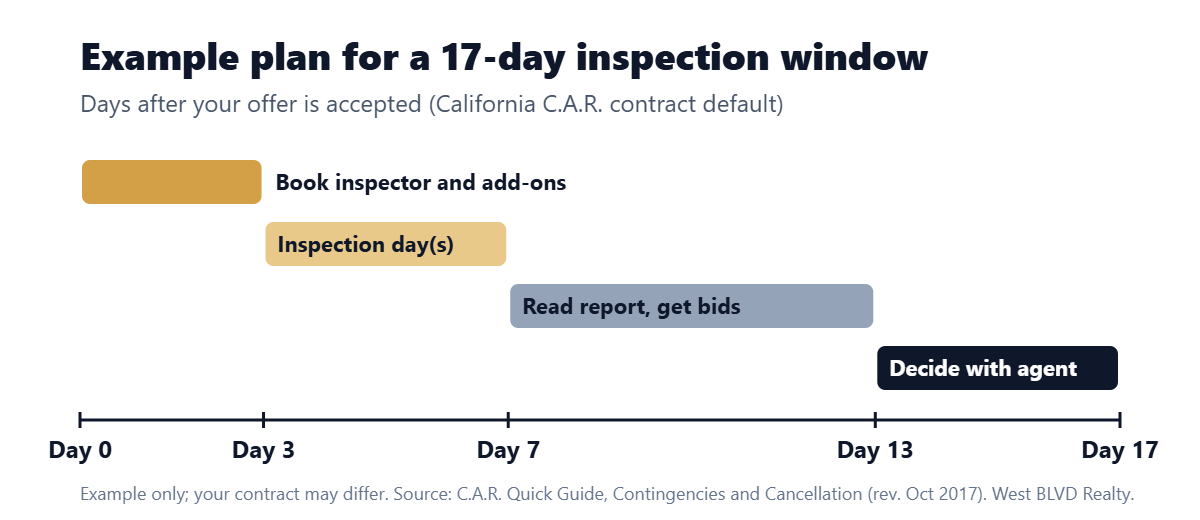
A simple way to use those days:
- Book the home inspection and any add-ons in the first few days.
- Attend the inspection and take your notes and photos.
- Read the full report, and get repair bids for anything major.
- Talk with your agent about what to request, and decide before the deadline.
Repairs or credits affect your cash at closing, so it helps to know the closing costs buyers pay in Long Beach. If you’re still house hunting, our tips on making a competitive offer and our step-by-step home buying guide cover the steps before this one.
This is general information, not legal or inspection advice. Ask your agent, inspector or attorney how it applies to your purchase.
Frequently asked questions
Does the buyer attend the home inspection?
Usually, yes. The buyer hires the inspector, so buyers are welcome to attend. If you can’t stay the whole time, be there for the walk-through at the end, when the inspector explains the findings.
Do I need to bring tools to a home inspection?
No. The inspector brings the ladder, flashlight, testers and other equipment. Bring your phone, a way to take notes, a tape measure and your questions.
Should the seller be home during the inspection?
Sellers are often away during the buyer’s inspection. It gives the inspector room to work and lets you ask questions freely. If you’re selling, see how sellers prepare a home for inspection.
Is a termite inspection part of a home inspection in California?
No. In California, an opinion on termites and other wood-destroying pests has to come from an inspection by a licensed pest company. Ask your agent whether one has been ordered.
How long do I have to decide after the inspection?
It depends on your contract. In California Association of REALTORS® purchase agreements, the investigation contingency defaults to 17 days unless the contract sets a different number. Check your contract for your exact date.
Buying in Southern California?
We help buyers line up inspections, read the report and decide what to ask for before the deadline. See our buyer services or get in touch.
Learn More About This Topic
Related Service: This article is part of our Buying & Home Search series. For complete service details and reliable care in Long Beach, explore our service page: Home Buyer Representation.