


Short answer: In California, a buyer usually has 17 days after the seller accepts the offer to complete inspections, unless the contract says otherwise. Use that window to order a general home inspection and a separate termite (wood-destroying pest) report. Add a sewer scope, roof or foundation inspection when the home calls for it. Walk the checklist below with your inspector, read the seller’s required state disclosures, and decide on repairs or credits before you remove your contingency.
This checklist is written for buyers in Long Beach and across Los Angeles and Orange County, where many homes are older and earthquake and permit questions come up often. If you’re getting ready for the appointment itself, see what to bring to a home inspection. Buying a rental building in Long Beach? Here’s our Long Beach habitability inspection checklist for city rental inspections.
California inspection timeline at a glance
| Step | Typical timing | Source |
|---|---|---|
| Investigation (inspection) contingency | 17 days after acceptance by default on the C.A.R. purchase agreement; can be shortened or lengthened in the contract | C.A.R. Quick Guide |
| Seller’s Transfer Disclosure Statement (TDS) | Delivered by the seller as soon as practicable before close of escrow | Civil Code §1102.3 |
| Lead-based paint (homes built before 1978) | Buyers get a 10-day opportunity to test for lead hazards unless they waive it | U.S. EPA |
| Removing the contingency or asking for repairs | In writing, before the period ends (C.A.R. forms CR and RR) | C.A.R. Quick Guide |
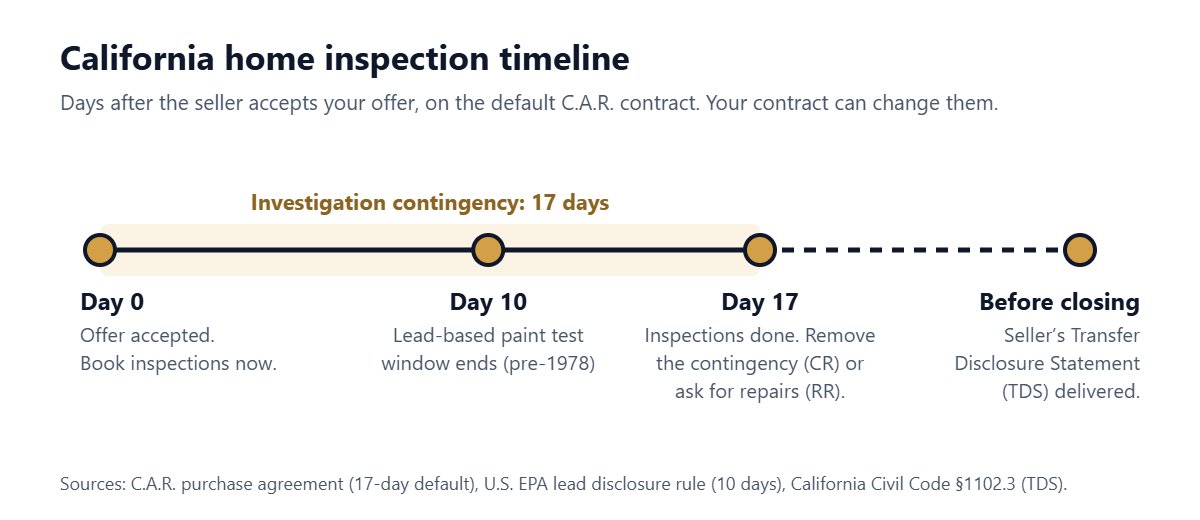
Book the inspector the day your offer is accepted. Reports can take a day or two, and you’ll want time for follow-up inspections.
Which inspections California buyers order
| Inspection | Who does it | When it’s worth it |
|---|---|---|
| General home inspection | A home inspector | Almost always. Covers the visible condition of the structure and systems. |
| Wood-destroying pest (termite) report | A company licensed by the Structural Pest Control Board | Almost always. A general home inspection doesn’t cover termites or dry rot. |
| Sewer line camera scope | A plumber | Older homes, homes with large trees near the line, or any sign of slow drains. |
| Roof inspection | A licensed roofing contractor | When the inspector notes wear, leaks or a roof near the end of its life. |
| Foundation or structural evaluation | A structural engineer | Cracks, sloping floors, sticking doors or a raised foundation without earthquake bolting. |
| Chimney, pool, HVAC, mold or lead testing | Specialists | When the home has the feature or the general inspector recommends it. |
The California home inspection checklist
Use this list to follow along during the inspection and to read the report afterward. Items marked (CA) are California-specific.
Grounds, drainage and exterior
- Soil slopes away from the house; downspouts drain away from the foundation
- No standing water, eroded areas or cracked driveways pushing toward the house
- Siding, stucco and trim: cracks, gaps, peeling paint, wood rot
- Fences, retaining walls and decks: leaning, rot, loose railings
- Trees close to the house, the roof or the sewer line
Roof, gutters and attic
- Missing, curled or cracked shingles or tiles; worn flat-roof surfaces
- Flashing around chimneys, vents and skylights
- Gutters attached and clear
- Attic: signs of leaks, insulation level, ventilation, pest activity
Foundation, structure and earthquake safety (CA)
- Cracks in the foundation, sloping floors, doors or windows that stick
- For raised foundations: anchor bolts connecting the house to the foundation, and bracing of any short “cripple walls” in the crawl space
- Crawl space: moisture, wood rot, plumbing leaks, pest damage
- Chimney: cracks, leaning, missing cap
- For homes built before 1960, the seller should provide the Homeowner’s Guide to Earthquake Safety and an earthquake hazards disclosure (Government Code §8897.1) (CA)
Water heater (CA)
- Strapped or braced against earthquake movement, as Health and Safety Code §19211 requires
- Age, rust, leaks, and a working temperature and pressure relief valve with a discharge line
- Proper venting for gas units
Smoke and carbon monoxide alarms (CA)
- Smoke alarms in the locations state law requires; the seller must certify compliance in writing (Health and Safety Code §13113.8)
- Carbon monoxide alarms in homes with a gas appliance, fireplace or attached garage (SB 183)
Electrical
- Panel brand and condition; older Federal Pacific and Zinsco panels are often flagged for replacement
- Ungrounded outlets, missing GFCI protection in kitchens, bathrooms, garages and outdoors
- Exposed or amateur wiring, especially in additions and garages
Plumbing and sewer
- Supply pipe material (copper, PEX, or older galvanized steel that may need replacing)
- Water pressure, leaks under sinks, slow drains
- Main shut-off location; gas shut-off and whether it has a wrench nearby
- Whether a sewer scope is recommended
Heating and cooling
- Age of the furnace and A/C, and whether both run
- Filters, ductwork condition, airflow to each room
- Wall heaters and floor furnaces in older homes: clearance and venting
Kitchen, bathrooms and interior
- Appliances that stay with the house actually work
- Water stains on ceilings and under sinks; soft floors around toilets and tubs
- Bathroom fans vent outside
- Windows open, close and lock; safety glass where required
- Signs of mold, odors or fresh paint over stains
Garage, additions and permits (CA)
- Garage conversions, room additions, ADUs and patio enclosures: ask the seller for permits and check the city’s permit records
- Firewall and self-closing door between the garage and the house
- Unpermitted work can affect insurance, financing and resale, so raise it during your contingency, not after
Disclosures the seller must give you in California
The inspection shows what the inspector can see. The seller’s disclosures tell you what they know. Read them side by side.
- Transfer Disclosure Statement (TDS) and the seller’s property questionnaire: known defects and history (Civil Code §1102)
- Natural Hazard Disclosure (NHD): flood, fire and earthquake fault and seismic hazard zones (Civil Code §1103)
- Water heater and smoke alarm statement of compliance (Health and Safety Code §§19211 and 13113.8)
- Lead-based paint disclosure for homes built before 1978 (EPA)
How home inspectors work in California
California doesn’t issue a state license for general home inspectors. Instead, the Business and Professions Code sets the rules:
- Inspectors must work with the care of a reasonably prudent home inspector (§7196).
- They can’t sell you repairs on a home they inspected in the past 12 months, and can’t pay agents for referrals (§7197).
- A contract clause that waives that duty or caps their liability at the inspection fee is invalid (§7198).
Because there’s no license, ask about:
- Membership in a professional association with a standard of practice, such as CREIA, ASHI or InterNACHI
- How many homes like this one (age, size, raised foundation or slab) they inspect
- A sample report, and whether it includes photos
- Whether you can attend (you should)
After the report: what to do next
- Sort the findings into safety issues, big-ticket items (roof, foundation, sewer, electrical panel), and normal wear.
- Get estimates for anything major from a licensed contractor while you’re still in your contingency period.
- Decide how to respond: ask the seller for repairs, a price reduction or a credit (C.A.R. Request for Repair), accept the home as is, or cancel within the contingency period.
- Remove the contingency in writing only when you’re satisfied, before the deadline.
Your agent’s job is to turn the report into a clear request the seller can say yes to. Learn how Theary handles this as part of buyer representation, or start with first-time homebuyer guidance.
Ready to Buy or Sell in Southern California?
Home inspection FAQ
Is a home inspection required in California?
No law requires a buyer to get one, but nearly every buyer should. The standard C.A.R. purchase agreement gives you a 17-day investigation period by default to do it.
Does a home inspection include termites?
No. Termites and wood rot are covered by a separate wood-destroying pest report from a company licensed by the Structural Pest Control Board.
Do home inspectors need a license in California?
No. California has no state license for general home inspectors. Business and Professions Code §§7195–7199 set their standard of care, so check credentials and sample reports.
Can I back out after the home inspection?
Under the standard C.A.R. contract, yes, while your investigation contingency is still in place. Once you remove it in writing, cancelling can put your deposit at risk.
This checklist is general information, not legal advice. Contract terms vary, so confirm deadlines with your agent and escrow. Laws and forms checked November 2026.
Learn More About This Topic
Related Service: This article is part of our Buying & Home Search series. For complete service details and reliable care in Long Beach, explore our service page: Home Buyer Representation.