How to Price Your House to Sell in Long Beach (2026 Guide)

Updated November 19, 2026. Market figures are for October 2026 unless noted.

To price your house to sell in Long Beach, start from what similar homes near you actually sold for in the last few months, adjust for the differences, check that figure against the homes you’ll be competing with right now, and pick a number a buyer’s appraiser can support. Then watch the first two to four weeks closely. National data shows the discount grows the longer a home sits, so a price that’s off is cheaper to fix early than late.

Below are the current Long Beach numbers, what overpricing costs by week, the research on how the exact list price affects offers, and the California rules on price opinions and appraisals.

The Long Beach market your price walks into

Your list price is judged against everything else for sale and everything that just sold. Here’s where Long Beach stood in October 2026, from Redfin’s Long Beach housing market data (all home types, from MLS and public records).

Measure (Long Beach, Oct 2026)FigureChange vs Oct 2025
Median sale price$889,381+4.6%
Median price per square foot$620+2.4%
Sale-to-list price ratio99.2%−0.27 points
Homes sold above list price35.8%−0.28 points
Homes sold with a price drop29.8%+1.0 point
Median days on market51Same
Homes sold in the month607674 a year earlier

Two things stand out. First, this is a balanced market, not a frenzy: Redfin rates Long Beach “somewhat competitive,” says the average home sells for about 1% below list and goes pending in about 52 days, while the hottest homes sell about 1% above list and go pending in about 27 days. Second, close to 3 in 10 homes that sold needed a price drop first. Zillow’s Long Beach home value index tells a similar story: $854,209 in October 2026, up 2.2% in a year.

For the longer view of prices across the 17 cities we serve, see our Long Beach home price history, and for month-by-month trends, the Long Beach housing market report.

What overpricing costs, week by week

The National Association of Realtors asks recent sellers how their sale price compared with their final list price. In the 2025 Profile of Home Buyers and Sellers (sales from July 2024 to June 2025), the answer depended on how long the home sat:

Time on marketSale price as % of final list price (median)
Less than 1 week100%
1 to 2 weeks100%
3 to 4 weeks99%
5 to 8 weeks98%
9 to 16 weeks96%
17 weeks or more94%
All sellers99%
Bar chart of median sale price as a percent of list price by weeks on market, from 100% under two weeks to 94% at 17 weeks or more

On a home at Long Beach’s $889,381 median, the gap between 99% and 94% is about $44,500 (our calculation). And that understates it, because NAR compares the sale price with the final list price, after any cuts. A home that sat for months usually came down from a higher first price too.

The pressure to cut is real right now. In the four weeks ending September 20, 2026, Redfin found 21.1% of U.S. sellers with active listings cut their price, the highest for that time of year in its records, and 16.5% in the Los Angeles metro, up 2.1 points (Redfin, September 30, 2026). Realtor.com counted 17.5% of active Los Angeles metro listings with a price reduction in October (Realtor.com October 2026 report).

The good news: NAR’s 2026 Profile (July 2025 to June 2026) found the median home sold in four weeks and 58% of sellers never reduced their price. Getting it right at the start is normal, not lucky.

How to price your house in 7 steps
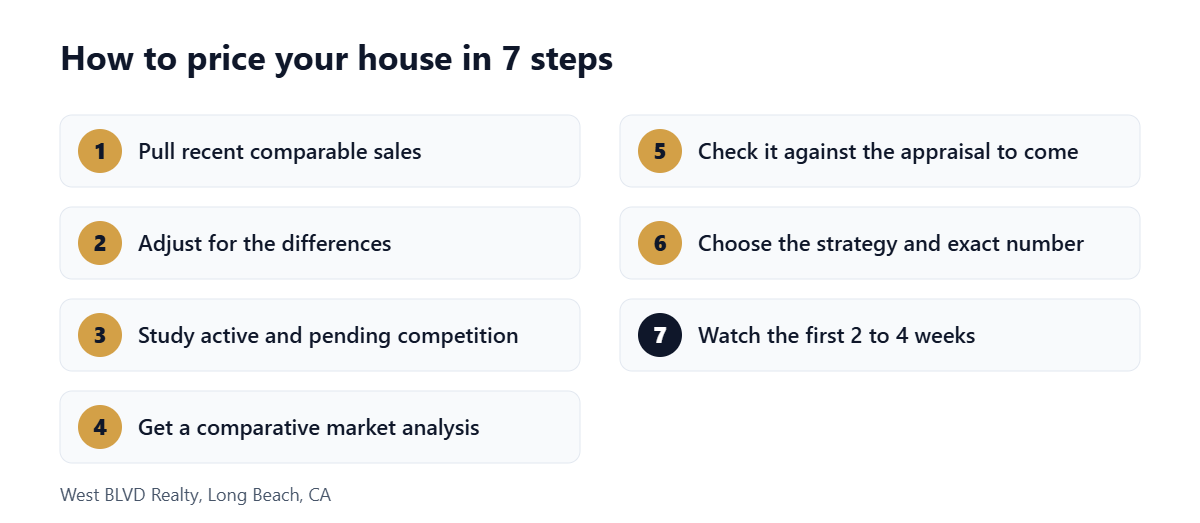
The 7 steps to price a house to sell, from comparable sales to watching the first weeks

1. Pull the right comparable sales

Comps are the closed sales a buyer, their agent and the appraiser will look at. Good comps are recent (ideally the last three to six months), close by (same neighborhood or ZIP, same side of any big dividing street), and similar in size, bedrooms, bathrooms, lot, age and condition. In Long Beach that matters more than usual: a Bixby Knolls ranch, a Belmont Shore condo and a North Long Beach starter home are different markets even within a few miles.

2. Adjust for the differences

No comp is a twin. Adjust up for what your home has that the comp didn’t (a remodeled kitchen, a garage, an extra bath, a bigger lot) and down for what it lacks. Price per square foot from comps is a quick check, not the answer: Long Beach’s median is $620 a square foot, but a condo, a duplex and a single-family home won’t share one number.

3. Study the competition you’ll list against

Sold comps show the past. Active and pending listings show the present: what buyers are choosing between this week. If three similar homes are sitting at $925,000 with price drops, listing at $949,000 tells buyers to wait for yours to drop too. If similar homes are going pending in under a month, you have more room.

4. Get a comparative market analysis

A comparative market analysis (CMA) puts steps 1 to 3 together in one report with a recommended price range. In California an agent can give you one without an appraiser license: Business and Professions Code §11302(b) says an appraisal “does not include an opinion given by a real estate licensee” in the course of their business, as long as it isn’t called an appraisal. West BLVD’s property valuation and CMA is free for Long Beach-area sellers.

5. Check the price against the appraisal to come

If your buyer finances, their lender will usually order an appraisal, and the loan is based on that value. Federal rules for national banks, for example, require a licensed or certified appraiser on most home loans above $400,000 (12 CFR 34.43). Fannie Mae can skip the appraisal through “value acceptance” for some loans, but not where the price or value is $1,000,000 or more (Fannie Mae Selling Guide B4-1.4-10), which covers many Long Beach homes. A price your comps can’t support may win an offer and then come apart at the appraisal, so stay inside the range the comps justify.

6. Choose your strategy and the exact number

Most sellers choose one of three approaches:

  • At market value: priced where the comps point. The default in a balanced market like Long Beach’s.
  • Slightly under market: meant to draw more showings and multiple offers. It works when demand is strong and your home shows well, but there’s no guarantee buyers bid it up.
  • Above market: “room to negotiate.” Per the NAR table above, this is the approach that tends to sit and sell at a discount.

Then pick the digits. The research here goes against some common advice. In a study of real home sales, Thomas, Simon and Kadiyali (Marketing Science, 2010) found buyers paid higher sale prices when list prices were more precise, such as $889,500 rather than $890,000. In a negotiation experiment, Cardella and Seiler (Journal of Economic Psychology, 2016) found a precise list price produced the highest final price and the smallest discount. And across more than 14,000 sales, Bucchianeri and Minson (2013) found higher starting prices were associated with higher selling prices, which is why the anchor matters, as long as it isn’t so high the home goes stale.

One practical limit: buyers search with a maximum price. A buyer whose search tops out at $900,000 never sees a home listed at $905,000, so check which side of a round number your price falls on.

7. Watch the first two to four weeks

Your listing gets the most attention when it’s new. Track showings, online saves, second showings and agent feedback. If you’re getting showings and no offers, buyers are telling you the price is ahead of the house. If you’re getting few showings, the price may be keeping you out of searches. NAR’s numbers say the discount starts to grow after about four weeks, so decide on any change with your agent by then, not after months.

Online estimate, CMA or appraisal?

EstimateWho makes itWhat it’s based onBest used for
Online estimate (Zestimate, Redfin Estimate)An algorithmPublic records and recent sales; nobody sees inside your homeA starting range
Comparative market analysisA licensed agentHand-picked comps, active and pending competition, your home’s conditionSetting the list price
AppraisalA licensed or certified appraiserAn inspection and comps under appraisal standardsThe lender’s loan decision; estates, divorces, disputes

How West BLVD Realty prices your home

Theary Pleng, broker, founded West BLVD Realty in 2014. Pricing is where most of the work happens before your home ever goes live:

  • A written CMA built from recent closed sales, current competition and a walk-through of your home.
  • A pricing plan that names the number, why, and what we’ll watch in the first weeks.
  • Prep that supports the price: staging, photos and the California seller disclosures done early so buyers trust what they see.
  • Full home seller representation from listing to close.

We price homes in Long Beach, Lakewood, Cerritos and the rest of our 17-city service area. For the full selling process, see our guide to selling your home.

Frequently asked questions

How much should I list my house for?

At the price recent comparable sales and current competition support, not the price you need or the highest online estimate. In Long Beach in October 2026 the median home sold for 99.2% of list, so a well-priced home should close near its asking price. A CMA from a local agent gives you the range.

How much above appraisal should I list my house?

Usually you won’t have an appraisal before listing; the buyer’s lender orders one after you accept an offer. If you list well above what comps support, the appraisal may come in low, and the lender lends on the lower value. Then the buyer pays the difference in cash, you renegotiate, or the deal may fall through, depending on your contract. Pricing within the comps avoids that.

Should I price my house below market to get multiple offers?

Sometimes. It can work for a home that shows well in a strong pocket, and about 36% of Long Beach homes sold above list in October 2026. But it’s a bet that buyers will compete, and in a balanced market they may not. Talk through your floor price before you choose it.

When should I reduce my price?

When the first weeks of showings and feedback say the price is the problem, generally before the four-week mark, when NAR’s data shows discounts start to grow. One well-judged cut usually beats several small ones that make buyers wait for the next.

Want a price you can trust? Contact West BLVD Realty or call (562) 537-5924 for a free comparative market analysis of your home.
How Listings Work on the MLS and Portals: A Long Beach Guide (2026)

Updated November 19, 2026. Rules are from CRMLS and the National Association of REALTORS®; buyer figures are from NAR’s 2025 Profile of Home Buyers and Sellers. Each is linked below.

When you sell a home in Long Beach, your agent enters it in the Multiple Listing Service (MLS). From there it reaches other agents and, through data feeds, home search sites like Zillow, Realtor.com and Redfin, where most buyers start. The rules for how and when that happens changed a lot in 2024–2026. This guide explains how it works now and what your options are as a seller.

What the MLS is, and which one covers Long Beach

An MLS is a shared database where brokers list homes for sale and other brokers find homes for their buyers. Long Beach is covered by the California Regional MLS (CRMLS), which serves the Pacific West Association of REALTORS® among many other local associations (CRMLS). CRMLS says it serves more than 103,000 real estate professionals and is one of the three largest MLSs in the country (CRMLS, July 2025).

Only licensed brokers (and appraisers) can join CRMLS, so a homeowner can’t post a listing directly. Some brokers offer limited-service or “MLS entry-only” listings, where they enter the home and you handle the rest (CRMLS rules).

How a listing reaches buyers

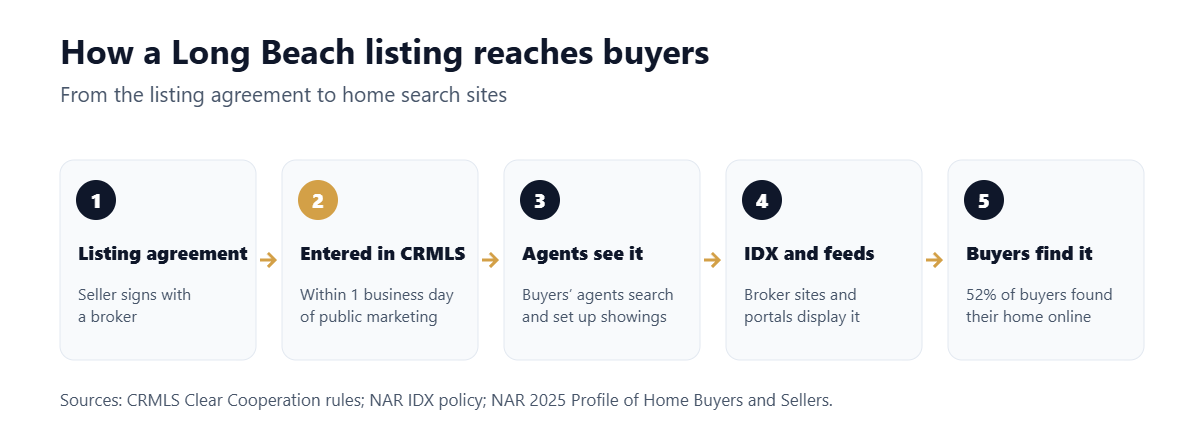
Five steps of a Long Beach listing: listing agreement, entered in CRMLS within 1 business day of public marketing, agents see it, IDX and portal feeds, buyers find it
  1. You sign a listing agreement with a broker. CRMLS expects the listing in the MLS within 2 days of the agreement’s effective date.
  2. It goes into CRMLS. Under CRMLS’s Clear Cooperation rule, once a home is marketed to the public (a sign, a website or social post, flyers, an open house), it must be in the MLS within 1 business day. Entering it late can bring a fine of 1% of the list price, from $500 to $2,500 (CRMLS Clear Cooperation).
  3. Other agents see it and bring their buyers to see it.
  4. It shows up online. Through IDX, other brokers can show MLS listings on their own websites (NAR, IDX policy), and listing feeds send them to the big portals.
  5. Buyers find it. All buyers in NAR’s 2025 survey used the internet in their search.

Why that reach matters

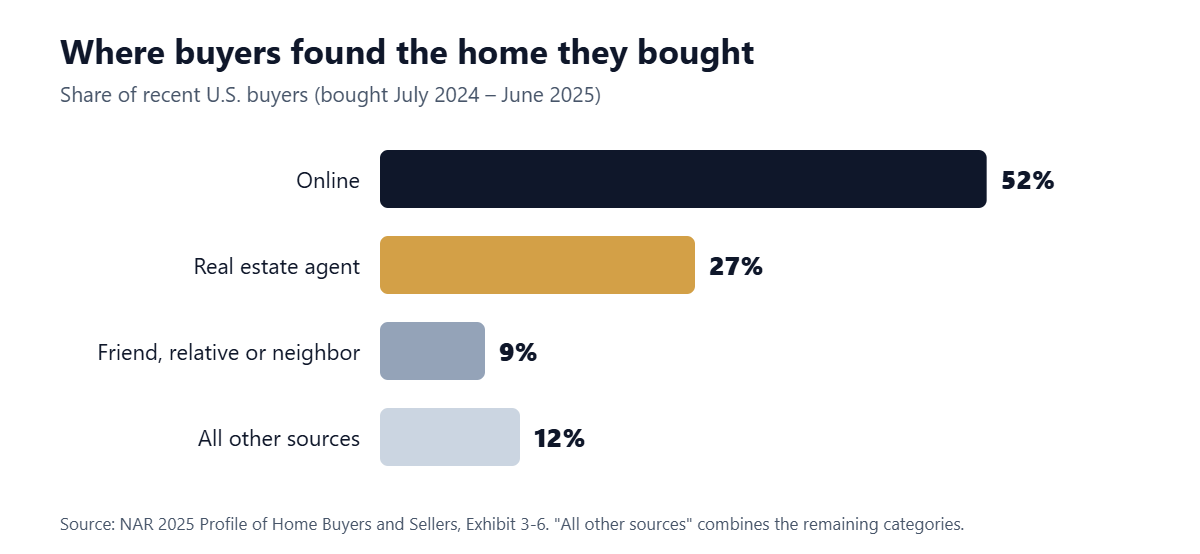
Bar chart from NAR 2025: 52% of buyers found their home online, 27% through an agent, 9% through a friend, relative or neighbor, 12% other sources

52% of recent buyers found the home they bought online, and 27% through an agent (NAR 2025 Profile, Exhibit 3-6). 88% bought through an agent or broker.

Research backs this up. A study of 32,102 listings found that when MLS member agents viewed a listing more, it was more likely to sell, sold for slightly more and sold faster (Allen, Dare and Li, Journal of Real Estate Finance and Economics, 2018). Zillow found that homes sold off the MLS from 2023 to 2025 went for 1.3% less, about $4,230 per home (Zillow, May 2026); Zillow is a party in the private-listing debate, so weigh that.

Your listing options in CRMLS

OptionWhat it isMain rules
ActivePublic listing for MLS agents, broker websites and portalsThe standard listing. A brokerage can opt out of IDX and syndication at the office level.
Coming SoonIn the MLS before showings beginNeeds a form signed by the seller. No showings, including virtual ones. Up to 21 days, then it becomes Active. Days on market don’t count.
Office exclusive (“Registered”)Not marketed to the publicFor sellers who don’t want public marketing. Entered as Registered within 2 days, with the seller’s signed exclusion form. Any public marketing triggers the 1-business-day rule.
Limited service or MLS entry-onlyAn MLS listing with fewer broker servicesA broker enters the listing but provides fewer services; you handle the rest.

Sources: CRMLS Clear Cooperation and CRMLS rules. In 2025 NAR added a “delayed marketing” option that keeps a listing off portals for a period, but CRMLS chose not to adopt it (CRMLS, April 2025).

What changed since 2024

DateChange
August 17, 2024Offers of pay to buyers’ agents are no longer allowed on the MLS, and buyers’ agents need a written agreement before touring homes with a buyer (NAR). Sellers can still offer it outside the MLS.
January 1, 2025California requires a written buyer-broker agreement by the time the buyer makes an offer, for no more than 3 months (Civil Code §1670.50).
March 25, 2025NAR’s “Multiple Listing Options for Sellers” policy; the 1-business-day rule stays (NAR). CRMLS didn’t adopt the delayed marketing part.
April 10, 2025Zillow said it would not show listings that were marketed privately before going on the MLS (Zillow).
February 6, 2026A federal judge denied Compass’s request to block that Zillow rule (NAR).
March 17, 2026Zillow launched “Zillow Preview,” which lets brokerages show pre-market listings on Zillow (Zillow).

Commission is negotiable and isn’t set by the MLS or by law. Redfin reported the average buyer’s agent commission at 2.42% in the third quarter of 2025 (Redfin). Our guide to selling a house in Long Beach covers seller costs in full.

Getting the listing right

  • Price it from recent sales. See our pricing guide.
  • Use good photos and present the home well; our staging guide covers what buyers notice. In California, virtually staged photos must be disclosed.
  • Check every fact (square footage, beds, baths, lot) before it goes live, since portals copy it word for word.
  • Have disclosures ready so buyers’ agents can act quickly. See California seller disclosures and the pre-listing inspection guide.
  • Decide on Coming Soon or an office exclusive before you market anything, because a sign or a social post starts the 1-business-day clock.

How West BLVD Realty helps

As your listing broker, we enter your home in CRMLS, choose the right listing status with you, and make sure the details and photos are right before they spread to every portal. See our home seller representation and home valuation services.

Frequently asked questions

What MLS covers Long Beach?

The California Regional MLS (CRMLS), which serves the Pacific West Association of REALTORS® and many other associations. Listings entered there reach other agents, broker websites and the big home search sites.

Can I list my house on the MLS without an agent?

Not directly: only licensed brokers and appraisers can join CRMLS. Some brokers offer limited-service or MLS entry-only listings, where they enter your home and you handle showings and negotiation.

How fast does a listing have to go on the MLS?

In CRMLS, within 1 business day after any public marketing, such as a yard sign, website or social post, and within 2 days of the listing agreement. A Coming Soon listing can sit in the MLS for up to 21 days with no showings.

Does Zillow get every MLS listing?

Not always. Brokerages can opt out of IDX and syndication at the office level, and office exclusives aren’t marketed publicly. In March 2026 Zillow also added a “Preview” option for pre-market listings.

This article is general information. MLS rules and portal policies change; ask your agent for the current rules before you list.

Thinking about selling in Long Beach? Contact West BLVD Realty or call (562) 537-5924.

California Seller Disclosures: Required Forms and What to Disclose (2026)

Updated November 19, 2026. Laws checked on the California Legislative Information site in November 2026. This is a plain-English guide, not legal advice; for a specific question about your sale, ask a California real estate attorney.

Short answer: When you sell a home in California, you must tell the buyer in writing about every material fact you know that affects the home’s value or desirability. Most sellers do that on a set of state forms. The main ones are the Real Estate Transfer Disclosure Statement (TDS) and the Natural Hazard Disclosure (NHD) Statement. Depending on the home, you may also need a lead paint disclosure, an earthquake guide, fire-zone documents, HOA documents and several short notices. Three new disclosure rules took effect on January 1, 2026: smoke residue, gas appliance rules and an electrical inspection advisory.

Every California Seller Disclosure in One Table

This table lists the state and federal disclosures a California home seller may owe, when each applies and the law behind it. Your agent and escrow officer will tell you which ones apply to your sale.

DisclosureWhat it coversWhen it appliesLaw
Transfer Disclosure Statement (TDS)The seller’s known defects, features and conditions, plus the agents’ visual inspectionMost sales of single-family residential property, unless exemptCiv. Code §1102
Natural Hazard Disclosure (NHD)Whether the home is in six mapped hazard zones (flood, dam inundation, fire, wildland fire, earthquake fault, seismic hazard)Sales covered by the TDS rulesCiv. Code §1103.2
Lead-based paint disclosureKnown lead paint and reports, the EPA pamphlet, and a 10-day chance to testHomes built before 1978EPA, Title X §1018
Earthquake guide and disclosureThe Homeowner’s Guide to Earthquake Safety and known weaknessesWood-frame homes of 1–4 units built before 1960Gov. Code §8897.1
Smoke alarm statementA written statement that working smoke alarms are installedSingle-family homesH&S Code §13113.8
Water heater bracingThe seller certifies the water heater is braced or strappedAll sales with a water heaterH&S Code §19211
Megan’s Law noticeA notice in the contract pointing to the state sex offender databaseEvery sale contract for 1–4 unitsCiv. Code §2079.10a
Mello-Roos, 1915 Act and PACE noticesSpecial taxes and assessments on the propertyWhen the property is in a district or has a PACE lienCiv. Code §1102.6b
Fire-hardening noticeKnown wildfire weak points and low-cost retrofits doneHomes built before 2010 in a High or Very High Fire Hazard Severity ZoneCiv. Code §1102.6f
Defensible space documentationProof of defensible space, or an agreement that the buyer will get itHomes in a High or Very High Fire Hazard Severity ZoneCiv. Code §1102.19
Former military ordnanceA known former munitions site within 1 mileOnly if the seller knows of oneCiv. Code §1102.15
Recent work on a quick resaleContractor work, contractor names and permitsSelling within 18 months of buyingCiv. Code §1102.6h
HOA documentsGoverning documents, budget, assessments, violations, inspection reports and moreCondos and homes in an HOACiv. Code §4525
Termite (structural pest) reportThe pest report and any completed-work noticeOnly when the contract or the buyer’s loan requires oneCiv. Code §1099

Window security bars and their quick-release mechanisms are disclosed on the TDS itself (Civ. Code §1102.16). Agents also use their own forms, such as the Seller Property Questionnaire, which ask more detailed questions than the TDS. Answer those with the same care.

Who Has to Fill Out the TDS

The TDS rules cover most sales of single-family residential property: sales, exchanges, installment contracts and leases with an option to buy. A seller can’t waive them, and selling “as is” doesn’t remove the duty (Civ. Code §1102.1). As-is means you won’t make repairs, not that you can stay quiet about what you know.

Some transfers are exempt from the TDS form under Civ. Code §1102.2, including:

  • Court-ordered sales, such as probate, bankruptcy and foreclosure sales.
  • Transfers to a lender after a default, and the lender’s own resale.
  • Sales by a trustee, executor, conservator or guardian.
  • Transfers between co-owners, to a spouse or close relative, or between spouses in a divorce.
  • Transfers to or from a government agency.

One catch for families: the trust exemption does not apply when the trustee is a person who is a trustee of a revocable trust and is a former owner of the home, or lived in it within the past year. An adult child selling a parent’s home through a living trust often still owes the TDS. Exempt or not, every seller must still disclose known material facts.

When Disclosures Are Due and When the Buyer Can Back Out

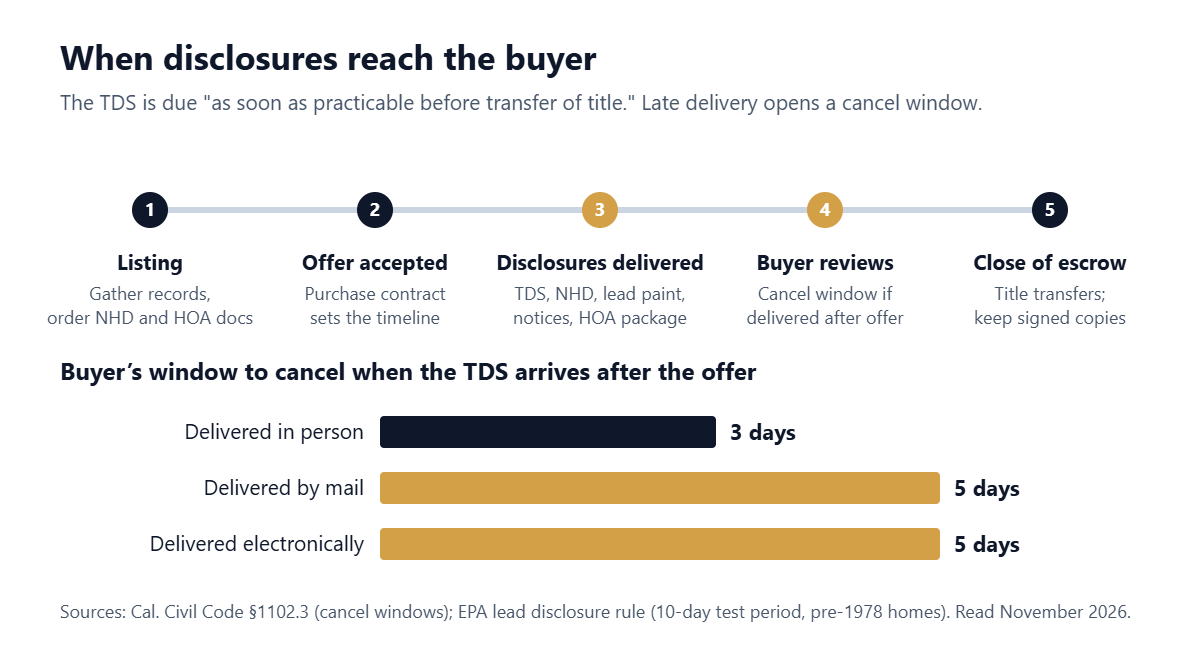
The law says the TDS goes to the buyer “as soon as practicable before transfer of title” (Civ. Code §1102.3). In practice it is delivered soon after the offer is accepted, on the timeline in the purchase contract.

If the TDS, or a material change to it, reaches the buyer after they made their offer, the buyer can cancel in writing:

How the disclosure was deliveredBuyer’s window to cancel
In person3 days after delivery
By mail5 days after mailing
Electronically5 days after delivery

That is why late changes cost sellers: a new fact you add near closing can reopen the buyer’s right to walk away. For homes built before 1978, the buyer also gets 10 days to test for lead paint unless they agree in writing to a different period or waive it (EPA).

Timeline of when California seller disclosures reach the buyer, with the 3- and 5-day cancel windows under Civil Code 1102.3

Natural Hazard Disclosure: The Six Zones

The NHD Statement (Civ. Code §1103.2) tells the buyer whether the home sits in any of these mapped zones:

  1. A FEMA special flood hazard area (Zone A or V).
  2. An area of potential flooding from a dam failure.
  3. A High or Very High Fire Hazard Severity Zone.
  4. A wildland area that may contain substantial forest fire risks.
  5. An earthquake fault zone.
  6. A seismic hazard zone (liquefaction or landslide).

Sellers usually fill out the statement from an NHD report ordered from a disclosure company. You can check the official maps yourself first: FEMA’s Flood Map Service Center, the California Geological Survey’s EQ Zapp for fault and seismic hazard zones, and the State Fire Marshal’s Fire Hazard Severity Zone maps. In Long Beach and the nearby cities we serve, check the flood and seismic hazard layers by address before you list.

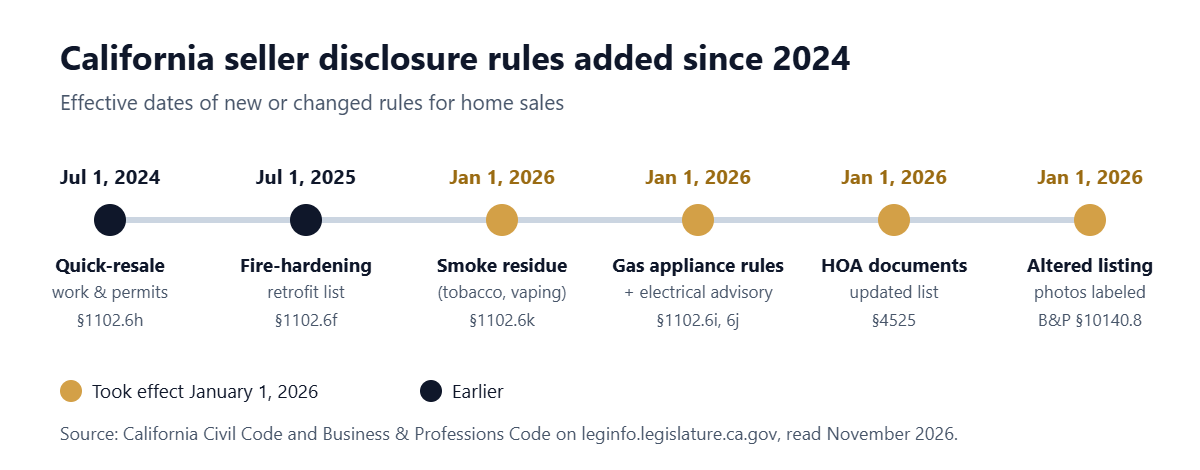
What’s New for California Sellers in 2025 and 2026

RuleWhat changedEffectiveLaw
Smoke residueDisclose known tobacco or nicotine smoke residue, or a history of occupants smoking or vapingJan 1, 2026Civ. Code §1102.6k (AB 455)
Gas appliance rulesDisclose known state or local rules on replacing gas appliances in the futureJan 1, 2026Civ. Code §1102.6j (SB 382)
Electrical inspection advisoryAn advisory to the buyer about having the electrical system inspectedJan 1, 2026Civ. Code §1102.6i (SB 382)
HOA documentsThe list of documents an HOA seller gives the buyer, including the latest elevated-element inspection reportJan 1, 2026 (amended)Civ. Code §4525 (SB 410)
Altered listing photosAgents must label digitally altered listing images and link the originalJan 1, 2026B&P Code §10140.8 (AB 723)
Fire-hardening retrofitsThe fire-hardening notice must list low-cost retrofits and which ones the seller completedJuly 1, 2025Civ. Code §1102.6f
Quick resalesDisclose contractor work and permits when selling within 18 months of buyingJuly 1, 2024Civ. Code §1102.6h (AB 968)
Timeline of California seller disclosure rules added since 2024, including three that took effect January 1, 2026

If your listing photos are virtually staged, the altered-image rule applies to the ads. Our home staging guide covers how to do that correctly.

Deaths, Megan’s Law and What You Don’t Have to Disclose

California sets a few limits on what a seller must volunteer (Civ. Code §1710.2):

  • Deaths: you don’t have to disclose a death on the property that happened more than 3 years before the buyer’s offer. A death within 3 years can be a material fact, so disclose it.
  • HIV and AIDS: you never have to disclose that an occupant had HIV or died of AIDS.
  • Direct questions: neither rule lets you lie. If a buyer asks directly about deaths on the property, you can’t knowingly misrepresent the answer.
  • Sex offenders: the Megan’s Law notice in the contract points buyers to the state database. Once that notice is given, you don’t have to provide more information about offenders nearby (Civ. Code §2079.10a).

Selling a Condo or a Home in an HOA

On top of the forms above, an HOA seller gives the buyer a package of association documents as soon as practicable before the sale closes (Civ. Code §4525). It includes:

  • The governing documents and any age restriction.
  • The current budget and annual disclosures.
  • A statement of assessments, fees, unpaid amounts and fines.
  • Any unresolved violation notices and any construction defect list.
  • Approved assessment increases that aren’t due yet, and any rental restriction.
  • The latest inspection report on balconies and other elevated elements.
  • Board minutes from the past 12 months, if the buyer asks.

Order the package from the HOA’s management company as soon as you list. It can take time to arrive, and its contents often raise buyer questions.

What Happens If a Seller Doesn’t Disclose

  • The sale stands, but you can owe damages. A missed TDS doesn’t undo the sale by itself, but a seller who willfully or negligently violates the rules is liable for the buyer’s actual damages (Civ. Code §1102.13).
  • Fraud claims run from discovery. A claim for fraud has a 3-year limit that doesn’t start until the buyer discovers the facts (Code Civ. Proc. §338). A problem you hid can surface years after closing.
  • Agents have their own duty. The listing agent and the buyer’s agent must each do a reasonably competent visual inspection of 1–4 unit homes and disclose what they find (Civ. Code §2079). A buyer has 2 years from closing or possession to sue a broker over that inspection (Civ. Code §2079.4).

The safest rule is simple: if you know about it and a buyer would care, write it down.

A Seller’s Disclosure Checklist

  1. Gather your records before you list: repair invoices, permits, insurance claims, past inspection and pest reports, and HOA documents.
  2. Check the hazard maps for your address (flood, fire and seismic), then order the NHD report through escrow.
  3. Note the age of the home. Built before 1978 means the lead paint forms; wood-frame and built before 1960 means the earthquake guide.
  4. Walk the home and confirm the smoke alarms, carbon monoxide alarms and water heater strapping.
  5. Fill out the TDS and your agent’s questionnaire yourself, from your own knowledge. Your agent can explain a question but shouldn’t answer it for you.
  6. Think about a pre-listing inspection. Finding problems early lets you fix, price or disclose them on your terms. See our pre-inspection guide.
  7. Deliver everything early and keep signed copies. Lead paint records must be kept for 3 years.
  8. Update in writing if anything changes before closing, knowing it may restart the buyer’s cancel window.

How West BLVD Realty Helps Sellers

Theary Pleng is a licensed California broker (DRE 01958287) who has represented sellers in Long Beach and nearby cities since 2014. When we list your home, we build the disclosure package with you from the first week, order the NHD and HOA documents early, and do the agent’s visual inspection the law requires. Disclosure problems are often pricing problems, so a comparative market analysis helps you decide whether to fix or disclose. Buyers will read your disclosures alongside their own inspection; our California home inspection checklist shows what they look for.

FAQs

What disclosures are required when selling a house in California?

Most sellers give the Transfer Disclosure Statement and the Natural Hazard Disclosure Statement, plus a smoke alarm statement, water heater certification and the Megan’s Law notice. Older homes add the lead paint disclosure (built before 1978) or the earthquake guide (wood frame, built before 1960). Fire zones, HOAs, special taxes and quick resales add their own forms.

Do I have to disclose a death in my house in California?

Not if the death happened more than 3 years before the buyer’s offer, and never that an occupant had HIV or died of AIDS. You still can’t lie if a buyer asks directly about deaths on the property.

Does selling “as is” mean I don’t have to disclose?

No. California law says the TDS duty can’t be waived, and an as-is sale still requires you to disclose known material facts. As-is only means you won’t make repairs.

Can a buyer back out after getting the disclosures?

Yes, if the disclosures arrive after the offer. The buyer can cancel in writing within 3 days of in-person delivery or 5 days of mail or electronic delivery. The purchase contract’s own contingencies may give the buyer other ways out.

Talk Through Your Disclosures

Getting ready to sell? Contact West BLVD Realty or call (562) 537-5924. Theary will walk you through which disclosures apply to your home, with no pressure.

How to Sell a House in Long Beach, CA: Step-by-Step Guide (2026)

Updated November 19, 2026. Long Beach figures are from Redfin through October 2026.

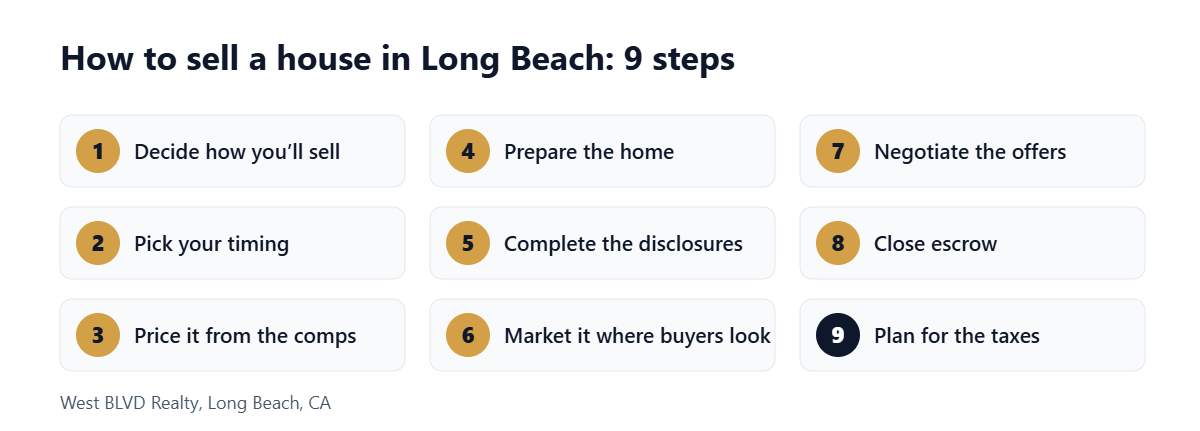
Selling a house in Long Beach takes nine steps: choose how you’ll sell, pick your timing, price it, prepare the home, complete California’s disclosures, market it, negotiate offers, close escrow, and handle the taxes. Most of the money is won or lost in the first four, before a buyer ever walks in.

This guide walks through each step with current Long Beach data, the seller costs on an example home, and the California tax and withholding rules most selling guides skip.

The 9 steps to sell a house in Long Beach, from choosing how to sell to planning for taxes

Long Beach for sellers right now

In October 2026 the median Long Beach home sold for $889,381, up 4.6% from a year earlier, at 99.2% of its list price after a median 51 days on the market. 35.8% sold above list, and 29.8% sold after a price drop (Redfin). Redfin says Long Beach homes get about 2 offers on average.

The wider region has tilted toward buyers. In October 2026 the Los Angeles metro had 72% more sellers than buyers, which Redfin counts as a buyer’s market (Redfin, November 12, 2026). Well-prepared, well-priced homes still sell; homes that aren’t tend to sit.

Step 1: Decide how you’ll sell

Most sellers use an agent: 91% of sellers in NAR’s 2025 Profile of Home Buyers and Sellers, an all-time high, against 5% who sold on their own. Commission is negotiable and isn’t set by law.

Two rule changes since 2024 matter to sellers. Under the NAR settlement, in effect since August 17, 2024, offers of compensation to the buyer’s agent can’t go on the MLS, though you can still offer one off the MLS and still offer buyer concessions, such as help with closing costs, on it (NAR settlement FAQs). And in California, since January 1, 2025, buyers sign a written agreement with their agent, no later than when they make an offer, that spells out what their agent is paid (Civil Code §1670.50). So decide with your agent, before listing, whether you’ll offer anything toward the buyer’s agent. Redfin’s latest national average for buyer’s agents was 2.42% in the third quarter of 2025 (Redfin).

Step 2: Pick your timing

Spring is the strongest season in Southern California. Zillow’s analysis of 2025 sales found Los Angeles metro homes listed in the last two weeks of April sold for 2.5% more than average, about $25,300 (Zillow, March 18, 2026). Redfin finds the most new LA listings arrive in mid-May (Redfin, September 2026).

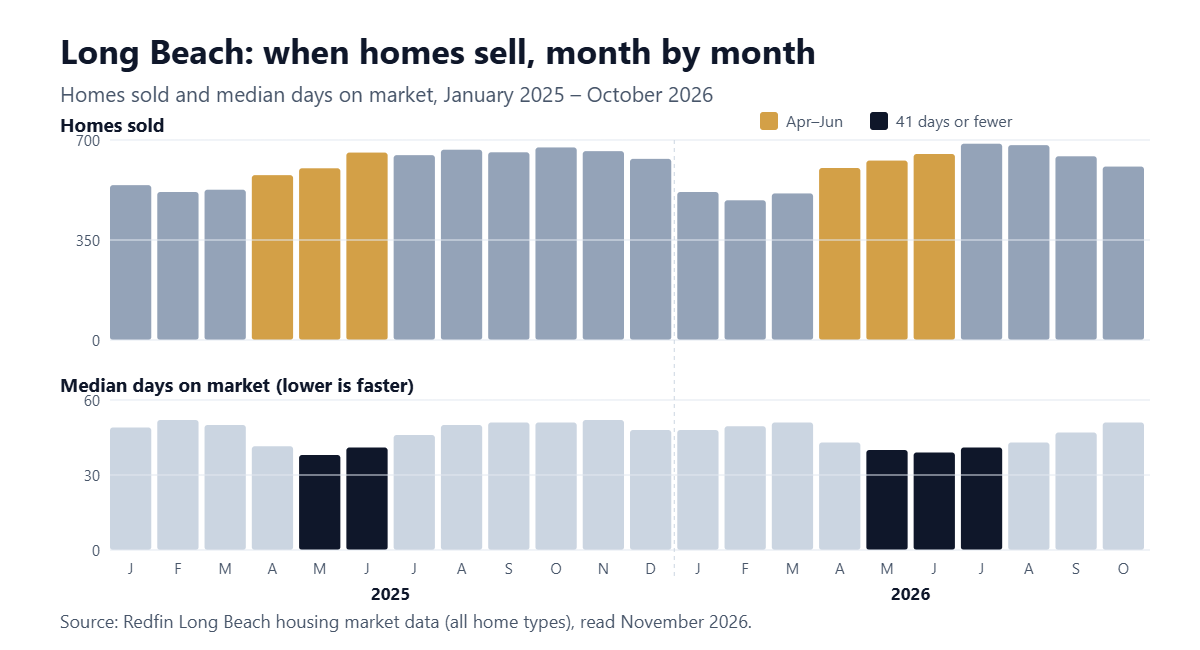
Long Beach’s own numbers show the same rhythm. Sales are lowest from January to March, homes sell fastest in May and June, and price drops are most common from August to October:

Bar charts of Long Beach homes sold and median days on market by month, January 2025 to October 2026
Long Beach, 2026Homes soldMedian days on marketSold with a price drop
February48949.520.6%
May6284025.2%
June6513927.3%
August6824330.1%
October6075129.8%

Monthly median prices move with the mix of homes that sell, so don’t read a “best month for price” into them. And your own timeline (a job move, a new home, a family change) matters more than a few weeks of seasonality. If you need to sell in winter, note that February 2026 had the smallest share of sales with a price drop all year.

Step 3: Price it from the comps

Price is the step that decides the rest. NAR’s data shows homes that sell within two weeks get a median 100% of list price, while those on the market 17 weeks or more get 94%. Our guide to how to price your house in Long Beach covers comps, the appraisal and the research on list prices, and West BLVD’s free comparative market analysis gives you a price range for your home.

Step 4: Prepare the home

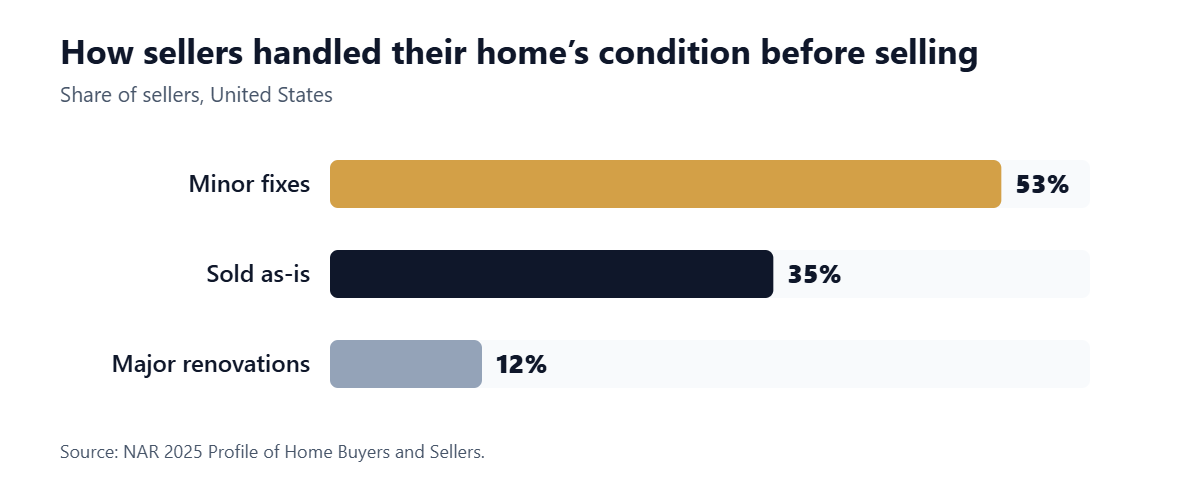
In NAR’s survey, 53% of sellers made minor repairs before selling, 35% sold as-is and 12% did major renovations. Focus on what buyers and inspectors will notice: deferred maintenance, safety items, and anything a buyer’s lender might flag. A pre-listing inspection can surface problems before a buyer does; see our pre-listing home inspection guide.

Then make it show well. Our home staging guide covers which rooms matter most and what staging costs, plus California’s rule for disclosing virtually staged photos.

Step 5: Complete California’s disclosures early

California sellers owe buyers a long list of disclosures: the Transfer Disclosure Statement, the Natural Hazard Disclosure, lead paint for pre-1978 homes, and more. Buyers can cancel within a few days of receiving a late TDS or NHD, so having them ready when you list keeps your deal from wobbling in escrow. Our California seller disclosure guide lists every form with its statute and the 2025–26 changes.

Step 6: Market it where buyers look

Buyers find homes online first. In NAR’s 2025 survey, 52% of buyers found the home they bought on the internet and 27% through an agent. The website features they rated most useful:

Listing featureBuyers who rated it “very useful”
Photos81%
Detailed property information77%
Floor plans57%
Agent contact information44%
Virtual tours38%

So professional photos and complete listing details come first. On the agent’s side, the most common marketing in the same survey was the MLS (85%), a yard sign (67%), open houses (59%) and the agent’s own website (49%). Keep the home on the MLS: Zillow found listings kept off it sold for a median 1.5% less, nearly $5,000 (Zillow, March 2026). For how the MLS feeds Zillow, Redfin and the other portals, see how listings work on the MLS and portals.

Step 7: Negotiate the offers

Compare offers on more than price: the buyer’s financing and down payment, the contingencies and their deadlines, the closing date, and any credits they ask for. In California a counteroffer is legally a new offer, not an acceptance; an acceptance “must be absolute and unqualified,” and a qualified one “is a new proposal” (Civil Code §1585). So countering ends the original offer, and the buyer is free to walk away.

Expect requests after the inspection, too. In NAR’s survey, 27% of sellers offered incentives: 11% helped with closing costs, 9% offered a home warranty and 7% gave a credit for repairs. A credit is often simpler than doing repairs during escrow, and lenders cap how much a seller can contribute (see the limits in our closing costs guide).

Step 8: Close escrow, and know your costs

Once you accept, escrow runs the timeline in your contract: the buyer’s deposit, inspections, the appraisal, loan approval and the final signing. Here is what a seller typically pays in LA County, on an $850,000 example:

Seller costOn an $850,000 saleNotes
Listing agent commissionNegotiatedSet in your listing agreement
Buyer’s agent compensation, if you offer itAbout $20,570 at 2.42%Optional; Redfin’s Q3 2025 national average (our calculation)
Owner’s title insurance policy$2,220Seller customarily pays in LA County; Old Republic filed rate
LA County documentary transfer tax$935$1.10 per $1,000; Long Beach adds no city tax
Escrow feeVariesCustomarily split with the buyer
HOA resale documents, if anyVariesCharged to the seller (Civil Code §4530)
Loan payoff and prorated property taxYour balancePaid from your proceeds

Two withholding rules apply at closing. California requires 3⅓% of the sale price to be withheld for state income tax unless an exemption applies, and the most common one is for a principal residence you owned and lived in for two of the last five years. You claim it on Form 593, given to escrow before closing; without it, escrow must withhold. The withholding is a prepayment, “not an additional tax,” per the FTB. Foreign sellers face separate federal withholding, generally 15% (IRS FIRPTA).

Step 9: Plan for the taxes

If the home was your main home, you may exclude up to $250,000 of gain from federal income tax, or $500,000 for a married couple filing jointly, if you owned and lived in it for at least two of the five years before the sale (IRS Topic 701, Publication 523). Gain above that is taxable. California has no lower rate for capital gains; it taxes them as ordinary income (FTB). Long-time Long Beach owners can have gains above the exclusion, so talk to a tax professional before you list.

How West BLVD Realty helps you sell

Theary Pleng, broker, founded West BLVD Realty in 2014. Our home seller representation covers every step above, from the CMA and pricing plan to prep, disclosures, marketing, negotiation and closing. We sell homes in Long Beach, Lakewood, Bellflower, Cypress and the rest of our 17-city service area. For where prices are heading, see the Long Beach housing market report.

Frequently asked questions

What is the best time to sell a house in California?

In the Los Angeles area, spring. Zillow found LA metro homes listed in the last two weeks of April sold for 2.5% more than average in 2025. In Long Beach, homes sold fastest in May and June 2026 (median 39 to 40 days). Your own timeline matters more than a few weeks either way.

How long does it take to sell a house in Long Beach?

The median Long Beach home sold after 51 days on the market in October 2026, per Redfin, and as few as 39 days in June 2026. Nationally, NAR’s 2025 survey found a median of four weeks. Add the escrow period in your contract after you accept an offer.

How much does it cost to sell a house in Long Beach?

The biggest costs are agent commission (negotiable) and any compensation you offer the buyer’s agent. On an $850,000 sale, a seller also typically pays about $2,220 for the owner’s title policy and $935 in LA County transfer tax, plus half the escrow fee and any HOA document charges.

Do I pay taxes when I sell my house in California?

If it was your main home for two of the last five years, you may exclude up to $250,000 of gain ($500,000 for married couples filing jointly) from federal tax. Gain above that is taxed, and California taxes capital gains as ordinary income. California also withholds 3⅓% at closing unless you claim an exemption on Form 593.

Thinking about selling? Contact West BLVD Realty or call (562) 537-5924 for a free comparative market analysis and a selling plan for your home.

Pre-Listing Home Inspection in Long Beach: A Seller’s Guide (2026)

Updated November 19, 2026. Laws were read on leginfo.legislature.ca.gov in November 2026.

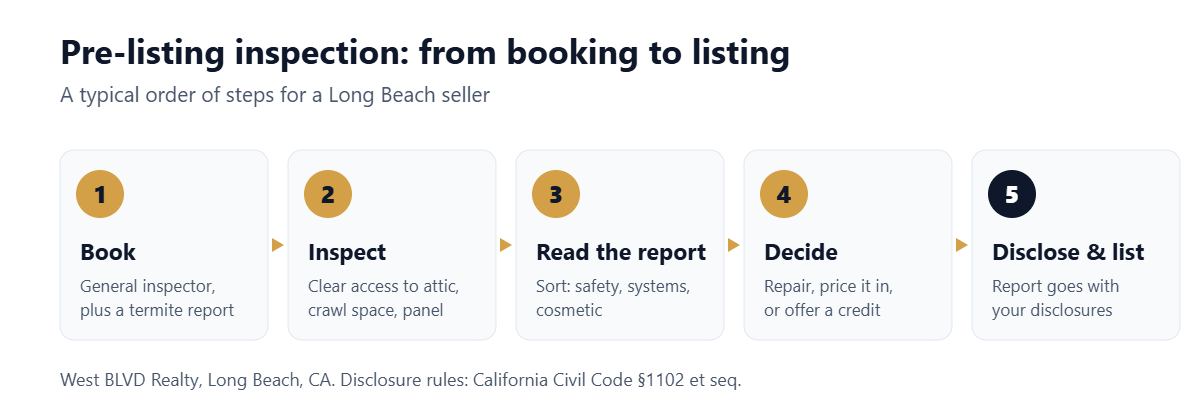
A pre-listing home inspection is a full inspection you order before your home goes on the market, so you find the problems before a buyer does. In Long Beach it usually means two reports, a general home inspection and a termite report. Your choices come after the reports: fix things, price them in, or plan a credit, and then disclose what the reports found.

This guide covers what the inspection checks, what it costs, the California items to handle before you list, the two city reports some local sellers need, and how disclosure works once you have a report.

Pre-listing inspection steps: book, inspect, read the report, decide, disclose and list

What a pre-listing inspection covers

California law defines a home inspection as a “noninvasive, physical examination” of a 1–4 unit home’s mechanical, electrical, plumbing and structural systems, to find material defects: conditions that significantly affect value, desirability, habitability or safety (Business and Professions Code §7195). If you have a pool or spa, the inspector also notes which drowning-prevention features it has.

Two things it doesn’t cover:

  • Termites and wood rot. That’s a separate report from a company licensed by the Structural Pest Control Board. It splits findings into Section 1 (visible active infestation or damage) and Section 2 (conditions likely to lead to it), under B&P §8516 and 16 CCR §1990.
  • Specialist checks. If the general inspector flags the roof, the sewer line, the foundation or the chimney, a specialist inspects that next.

Why sellers order one

Buyers still inspect. In NAR’s October 2026 survey of agents, only 19% of buyers waived the inspection contingency (NAR REALTORS® Confidence Index, November 12, 2026). When deals fall apart, the inspection is a common reason: in the last NAR survey we found that broke down terminations, 25% were due to inspection issues (January 2022).

Inspecting first lets you:

  • Fix problems on your schedule, with your own contractors and quotes, instead of during escrow.
  • Price the home with its condition already known.
  • Hand buyers a report up front, which tends to mean fewer surprises in their own inspection.

The trade-off: what you learn, you have to disclose (see below). Most sellers do some work either way. In NAR’s 2025 Profile, 53% of sellers did minor renovations or fixed broken items before selling, 35% sold as-is and 12% did major renovations (NAR 2025 Profile of Home Buyers and Sellers).

NAR 2025: 53% of sellers made minor fixes, 35% sold as-is, 12% did major renovations

What it costs

ItemCostWho needs it
General home inspectionAbout $330 average in Los Angeles; $344 national average, normal range $296–$425 (HomeAdvisor, updated June 19, 2026)Every pre-listing inspection. Larger and older homes cost more.
Termite (wood-destroying pest) reportAsk for a quote; prices vary by company and home sizeMost homes, since the general inspection doesn’t cover termites or wood rot
Long Beach Garage Resale report$125 for 1–2 units; $22 for an exemption certificate (City of Long Beach, rates effective October 1, 2026)Homes in Long Beach’s Parking Impacted Area only
Culver City Report of Building Records$96 residential (Culver City fee schedule, rev. 9/24); confirm with the cityEvery Culver City sale

California items to check before you list

Several things are required at the sale of a California home, and a pre-listing inspection is a good time to confirm them:

ItemThe ruleLaw
Water heaterBraced, anchored or strapped against earthquakes; you certify it to the buyer in writingH&S Code §19211
Smoke alarmsAn operable smoke alarm, with a written statement of compliance to the buyerH&S Code §13113.8
Carbon monoxide alarmsRequired in homes with a gas appliance, a fireplace or an attached garageH&S Code §17926
Plumbing fixturesDisclose in writing any toilets over 1.6 gallons per flush, showerheads over 2.5 gallons a minute or faucets over 2.2 gallons a minuteCivil Code §1101.4, §1101.3
Termite findingsSection 1 and Section 2 items listed separately in the reportB&P §8516

City reports in Long Beach and nearby

Two cities in our service area have a city step at sale:

  • Long Beach: if your home is in the Parking Impacted Area, the city’s Garage Resale Program requires a report on whether the legally required off-street parking is still there. Code Enforcement inspects, and reports take up to 5 business days. Condos and townhomes with shared parking, and homes that never had parking, can get an exemption certificate instead. Order it early: a converted garage can mean work before you sell.
  • Culver City: sellers apply for a Report of Building Records, and the city’s sale requirements also cover smoke detectors and an earthquake gas shutoff valve (Culver City Building Safety).

Carson dropped its Residential Property Report in 2019 (City of Carson). We found no city pre-sale report in our other service-area cities, but rules change, so we confirm with the city for every listing. See our Long Beach and Culver City pages.

You’ll need to disclose what it finds

California has no rule that says “disclose your pre-listing report” in those words, but the effect is the same. Your disclosures must be made in good faith, meaning “honesty in fact” (Civil Code §1102.7), and the disclosure form’s checklist doesn’t limit your duty to avoid fraud or misrepresentation (§1102.8). Once you’ve read a report, its findings are things you know.

Handing the report over also protects you. If you give the buyer a report from a licensed contractor, pest control operator, engineer “or other expert,” you generally aren’t liable for errors in it you didn’t know about (§1102.4). Disclose repairs you made too. Our California seller disclosures guide covers every form.

Choosing the inspector

California law sets duties for home inspectors (B&P §§7195–7199) but doesn’t require a state home inspector license. So check:

  • Membership in an association with a standard of practice, such as CREIA, ASHI or InterNACHI.
  • A sample report, so you know what you’ll get: photos, clear priorities, plain language.
  • Independence. An inspector can’t offer to do repairs on a home they inspected in the past 12 months, or pay agents for referrals (§7197).

Before inspection day, clear access to the attic, crawl space, electrical panel, water heater and furnace, and make sure utilities and pilot lights are on. Our home inspection checklist shows what inspectors look at, system by system.

Fix it, price it in, or offer a credit

Sort the report into three groups:

  • Safety and required items: fix these. Some are required at sale (water heater straps, alarms), and buyers are likely to ask about the rest (active leaks, electrical hazards, Section 1 termite work).
  • Major systems near the end of their life (roof, HVAC, sewer line): get a licensed contractor’s quote. Then repair, or disclose and price it in, or plan a credit. A credit is often simpler than repairs during escrow, but lenders cap seller contributions; see the limits in our closing costs guide.
  • Cosmetic items: handle them as part of staging, if at all.

Keep invoices and permits for everything you fix, and give copies to the buyer.

How West BLVD Realty helps

When we represent sellers, we plan the inspection with you, check whether your home needs a city report, read the reports with you, and build what they find into a pricing analysis and your disclosures. For the whole process, see our step-by-step guide to selling a house in Long Beach.

Frequently asked questions

Should I get a pre-listing inspection before selling my house?

Usually yes, especially for an older home or one with systems you haven’t checked in years. Buyers still inspect: only 19% waived the inspection contingency in NAR’s October 2026 survey. Finding problems first lets you fix or price them before a buyer uses them to renegotiate.

How much does a pre-listing inspection cost in Long Beach?

HomeAdvisor’s June 2026 guide puts the average home inspection in Los Angeles at about $330, with a national normal range of $296–$425. A termite report costs extra, and so does the city’s Garage Resale report ($125 for 1–2 units) if your home is in Long Beach’s Parking Impacted Area.

Do I have to disclose a pre-listing inspection report in California?

What the report finds becomes something you know, and California requires sellers to disclose known material facts in good faith (Civil Code §§1102.7 and 1102.8). Giving buyers the expert’s report also limits your liability for errors in it you didn’t know about (§1102.4).

Does a home inspection include termites?

No. A wood-destroying pest report is separate and must come from a company licensed by California’s Structural Pest Control Board. It lists Section 1 items (active infestation or damage) and Section 2 items (conditions likely to lead to it).

This article is general information, not legal or tax advice. Rules change; check the current law and talk with a licensed professional about your property.

Thinking about selling in Long Beach? Contact West BLVD Realty or call (562) 537-5924 to plan your pre-listing inspection.

Home Staging Strategies That Help Long Beach Homes Sell (2026)

Updated November 19, 2026. Survey figures are from the National Association of Realtors’ 2025 Profile of Home Staging; Long Beach figures are Redfin’s October 2026 data.

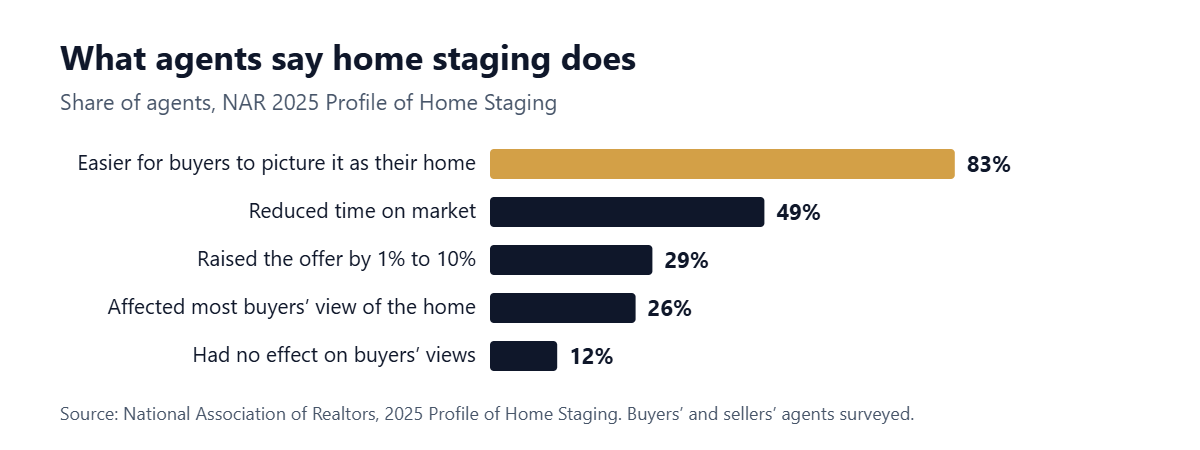
The short answer: Home staging means preparing and furnishing a home so buyers can picture living in it. In NAR’s 2025 survey, 49% of sellers’ agents said staging cut the time on market, and 29% saw offers rise 1% to 10%. The strategies that matter most cost little: declutter, clean, fix curb appeal, and stage the living room, primary bedroom and kitchen first. If you use virtual staging in California, the law now requires a disclosure and a link to the unaltered photo.

What is home staging?

Home staging is getting a house ready for sale so it shows at its best, in person and in the listing photos. It can be as simple as clearing counters and rearranging furniture, or as full as renting furniture and decor for an empty home. The goal is not to decorate to your taste. It is to help a buyer imagine their own life there.

That matters because sellers stop seeing their own homes clearly. NAR’s deputy chief economist notes that the typical seller has lived in the home for 10 years before selling, long enough to overlook what a buyer will notice in the first minute.

What staging actually does (the 2025 data)

NAR surveyed 1,266 Realtors in February 2025. These are agents’ reports, not a controlled study, but they are the most recent national figures.

FindingShare of agents
Buyers’ agents: staging made it easier for buyers to picture the home as their future home83%
Sellers’ agents: staging reduced time on market (30% slightly, 19% significantly)49%
Agents: staging raised the dollar value offered by 1% to 10%29%
Buyers’ agents: staging affected most buyers’ view of the home26%
Buyers’ agents: staging had no effect on buyers’ views12%
Bar chart of NAR 2025 staging findings: 83% easier to picture the home, 49% less time on market, 29% higher offers, 26% affected most buyers, 12% no effect
What buyers’ and sellers’ agents told NAR about staging. Source: NAR 2025 Profile of Home Staging.

Source: NAR, 2025 Profile of Home Staging.

Why it matters in Long Beach right now

In October 2026, the median Long Beach home took 51 days to sell and sold for 99.2% of its list price, per Redfin. Fewer homes sold than a year earlier (607 vs 674). With buyers taking their time and comparing listings, a home that photographs and shows well has an edge. See the full numbers in our Long Beach housing market report.

9 home staging strategies, in order of payoff

The first three are the steps agents recommend most often. NAR found sellers’ agents most often told clients to declutter (91%), clean the whole home (88%) and improve curb appeal (77%).

1. Declutter and depersonalize

Clear every counter, shelf and surface to a few pieces. Pack family photos, collections, kids’ artwork and anything with names on it. Thin out closets by about half, because buyers open them. Rent a storage unit or a portable container if you need to. You are moving anyway, so this is packing early.

2. Deep clean everything

Windows inside and out, grout, baseboards, light fixtures, the inside of the oven and fridge. Clean carpets or replace them if they are stained. Remove pet odors and any smoke smell. A clean home reads as a well-maintained home.

3. Fix curb appeal

Buyers see the front of the house first, online and in person. Mow, edge and weed; add fresh mulch; trim shrubs away from windows; paint or replace a tired front door; replace dated house numbers and the porch light; set a clean mat and one or two potted plants by the door.

4. Stage the rooms buyers care about most

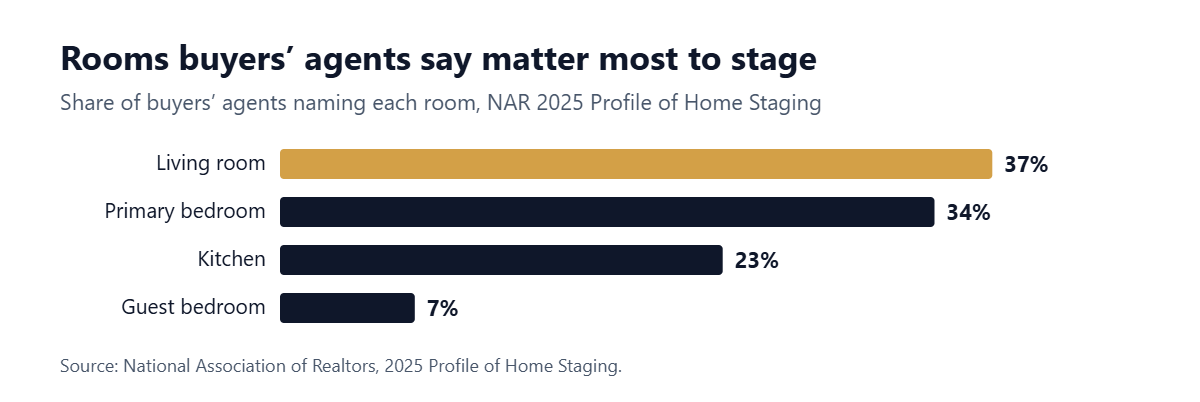
If time or budget is short, put your effort where buyers look. In NAR’s survey, buyers’ agents ranked the living room most important to stage (37%), then the primary bedroom (34%) and the kitchen (23%). The guest bedroom ranked least (7%).

Bar chart of rooms buyers agents say matter most to stage: living room 37%, primary bedroom 34%, kitchen 23%, guest bedroom 7%
Rooms buyers’ agents ranked most important to stage. Source: NAR 2025 Profile of Home Staging.
  • Living room: float the sofa off the walls to create a conversation area, remove extra chairs, add one rug that fits the space, and keep a clear walkway.
  • Kitchen: leave at most two or three items on the counters, clear the fridge door, and replace worn cabinet hardware if it looks dated.
  • Dining area: a simple table with chairs pushed in, and nothing on it but a bowl or a centerpiece.

5. Stage the bedrooms for rest

A staged bedroom should look calm and roomy. Use the largest bed the room fits with space to walk around it, matching nightstands and lamps on both sides, crisp white or neutral bedding with a couple of pillows and a throw, and nothing under the bed or on the dresser. If a spare room holds exercise gear or storage, empty it and stage it as a bedroom or office so buyers know what it is.

6. Go neutral, but not empty

Repaint bold or dark walls in a light neutral. Swap loud bedding, towels and pillows for plain ones. Keep some warmth: a plant, a bowl of fruit, a folded throw. A room that feels lived in shows scale; an empty room often looks smaller than it is.

7. Maximize light

Open every blind and curtain for showings and photos. Replace burnt-out bulbs and use the same color temperature in every fixture in a room. Add a lamp to any dark corner, and clean the windows (strategy 2 again).

8. Make the layout obvious

Every room should have one clear purpose. Remove furniture that blocks paths or windows, and pull pieces into the room so it reads as usable space. Buyers walk through a home quickly, so they should never have to work out what a room is for.

9. Fix the small things buyers notice

Dripping faucets, sticking doors, cracked switch plates, loose handles and scuffed paint all suggest bigger problems. Fix them before listing. For larger items, a pre-listing inspection tells you what a buyer’s inspector will find; see our pre-listing home inspection guide.

Staging a home for a quick sale: a 7-day plan

DayWhat to do
1Walk through with your agent and list what goes, what stays and what gets fixed
2–3Declutter and pack; move extra furniture and boxes to storage
4Repairs and touch-up paint
5Deep clean, including carpets and windows
6Curb appeal, then arrange furniture, bedding and accessories room by room
7Photos on a bright day (or at twilight for the exterior), then list

DIY, professional or virtual staging?

OptionTypical costBest for
DIY with your own furnitureYour time, plus cleaning and small repairsOccupied homes in good shape
Agent-led stagingMedian $500 (NAR 2025)Occupied homes that need editing and a few accessories
Professional staging serviceMedian $1,500 (NAR 2025); vacant homes with rented furniture usually cost moreVacant homes, higher-priced homes, homes that have sat on the market
Virtual stagingPriced per photoVacant homes, online listings only (must be disclosed in California; see below)

NAR found that 21% of sellers’ agents stage all their listings, 10% stage only homes that are hard to sell, and 51% don’t stage but recommend decluttering and repairs. Who pays varies: 23% of sellers’ agents offer to stage the home themselves, and 17% said the seller pays.

How to stage a house for listing photos

Most buyers meet your home online first. In NAR’s survey, 88% of sellers’ agents said listing photos were very important to their clients, more than video (47%) or physical staging (43%). Staging for the camera is a little different from staging for a showing:

  • Clear more than you think. The camera exaggerates clutter. Remove cords, remotes, trash cans, toiletries, magnets and dish racks.
  • Hide cars and bins. Move cars off the driveway and put trash and recycling bins out of sight before exterior shots.
  • Turn on every light and open every blind, even in daytime, so rooms read bright and even.
  • Straighten everything: pillows plumped, towels folded and matched, bedding smooth, chairs pushed in.
  • Use a professional photographer. Wide-angle lenses, level verticals and well-balanced exposure are what make listing photos look professional. A twilight exterior shot helps a home stand out in search results.
  • Shoot the best features first. The first photo decides whether a buyer clicks. Lead with the strongest exterior or main living space.

Virtual staging in California: the 2026 disclosure rule

Since January 1, 2026, California Business and Professions Code section 10140.8 (AB 723) applies to any listing photo that a broker, agent or someone working for them has altered with editing software or AI to add, remove or change elements, including furniture, flooring, paint color, landscaping or the view.

  • The ad must carry a reasonably conspicuous statement, on or next to the image, that it has been altered.
  • It must link (by URL or QR code) to a public page that shows the original, unaltered image.
  • Ordinary edits such as lighting, white balance, color correction, cropping, straightening and exposure are not covered, as long as they don’t change how the property is represented.

Virtual staging still works well for a vacant home. It just has to be labeled, and buyers will see the empty room too, so the home should be clean and in good repair either way. For other seller disclosure duties, see our guide to California property disclosure laws.

Is home staging worth it?

For most sellers, the low-cost steps (decluttering, cleaning, curb appeal, small repairs) are clearly worth it, because they are the same steps agents recommend most and buyers notice first. Paid professional staging makes the most sense for vacant homes, higher-priced homes and homes that have already sat on the market. Weigh it against your price: on a home near Long Beach’s October 2026 median sale price of $889,381 (Redfin), even a 1% higher offer would be about $8,900, against NAR’s $1,500 median staging cost. A higher offer is not guaranteed, so treat that as the upside, not a promise.

Staging works best together with the right list price. See our guide to pricing your Long Beach home, or get a free comparative market analysis.

Selling in Long Beach or nearby?

Theary Pleng, broker and founder of West BLVD Realty, has helped Long Beach-area sellers since 2014. Before you list, she can walk through your home with you, tell you what buyers in your price range will notice, and help you decide what is worth fixing, staging or leaving alone. Learn more about our home seller representation, or request a free consultation.

Frequently asked questions

What does home staging mean?

Home staging means preparing a home for sale, by decluttering, cleaning, arranging furniture and adding decor, so buyers can picture themselves living there. It can be done by the seller, the agent or a professional stager, and in listing photos it can be done virtually.

Does staging help a home sell faster?

In NAR’s 2025 Profile of Home Staging, 49% of sellers’ agents said staging reduced the time a home spent on the market: 30% said slightly and 19% said significantly. These are agents’ reports rather than a controlled study.

How much does home staging cost?

NAR’s 2025 survey found a median cost of $1,500 when a staging service was used and $500 when the seller’s agent staged the home. Vacant homes that need rented furniture usually cost more.

Do I have to disclose virtual staging in California?

Yes. Since January 1, 2026, Business and Professions Code section 10140.8 requires a conspicuous statement that a listing image was digitally altered, plus a link or QR code to the original, unaltered image. Basic edits like lighting, cropping and color correction are exempt.